Have you ever typed “I am board” instead of “I am bored” in a text, and instantly realized it was wrong? Don’t worry—you’re not alone. English homophones like bored vs board confuse even native speakers. These two words sound identical but have entirely different meanings, spelling origins, and usage contexts. Misusing them can make sentences unclear, awkward, or even funny in unintended ways.
Many people search for bored vs board to solve this common confusion. From students writing essays, to professionals sending emails, to casual social media posts, knowing the difference is crucial. Some ask “How to spell board like I am bored?”, while others wonder “Being bored meaning” or want to understand board vs bored memes. This article will break down the difference between bored and board, explain their pronunciation, explore British vs American English spelling, highlight common mistakes, and provide real-life examples.
By the end, you’ll confidently answer questions like:
- Is it feeling bored or board?
- What is the difference between board and boring?
- How do I use bored in a sentence correctly?
- How to spell board games properly?
Whether you’re learning English or just want to avoid embarrassing typos, this guide covers everything you need.
Bored vs Board – Quick Answer
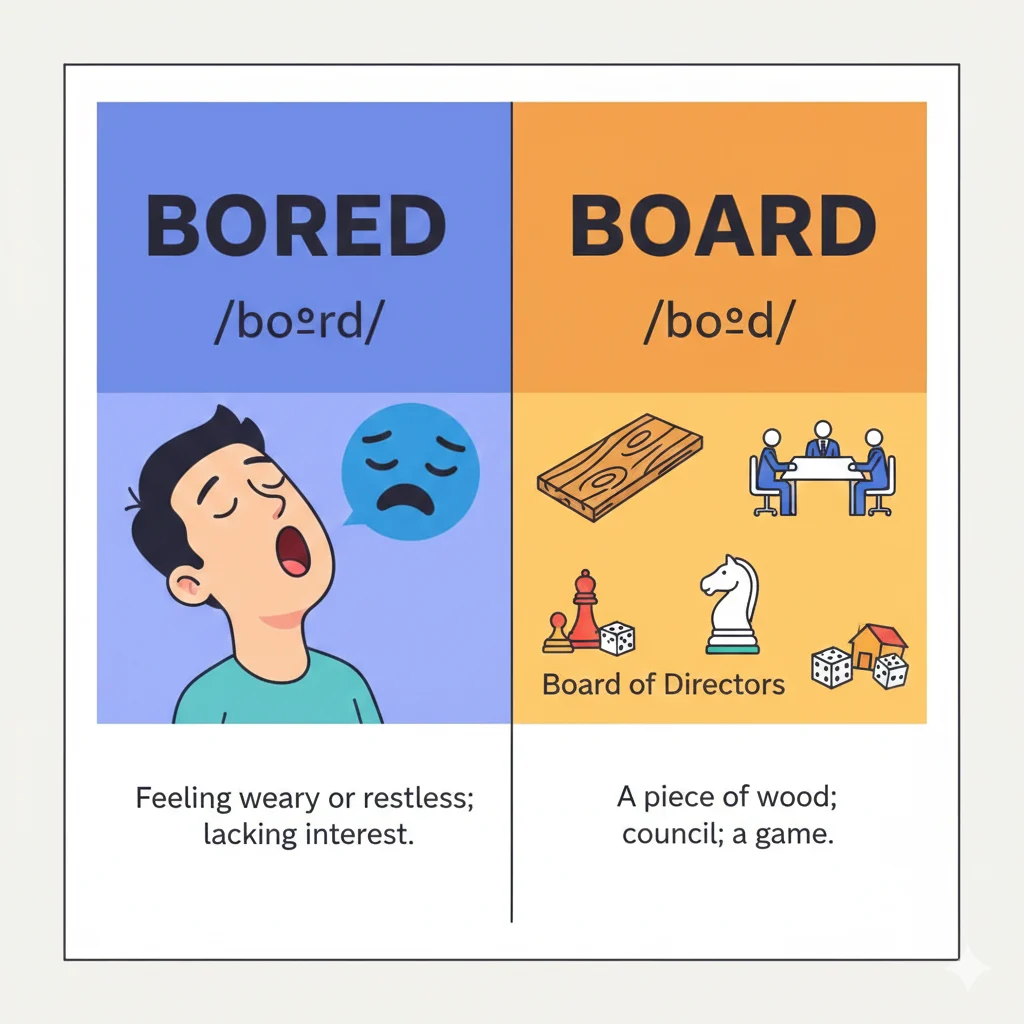
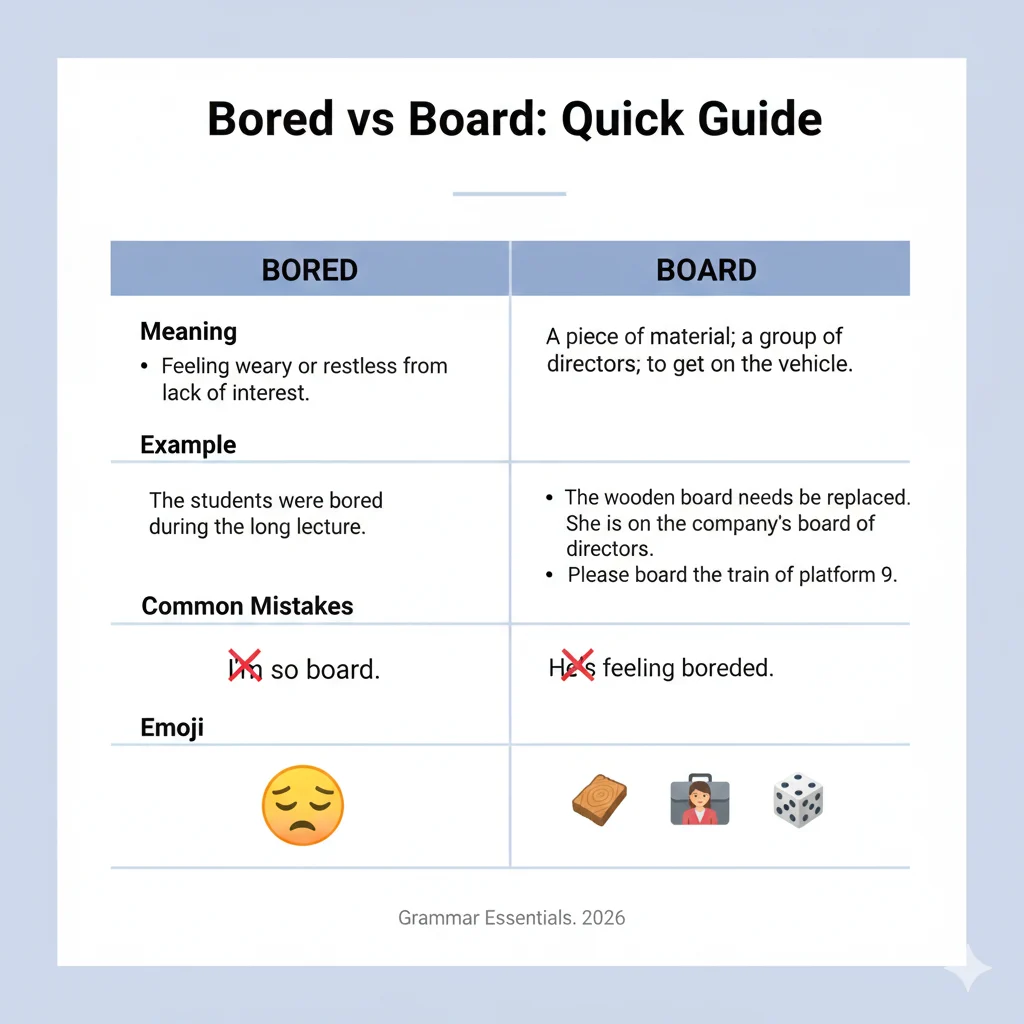
Bored is an adjective describing a state of being uninterested, tired, or weary.
Board is a noun or verb referring to:
- A flat surface or plank
- A governing group (board of directors)
- The act of getting on a vehicle (boarding a train, plane, or ship)
Examples:
- I am bored during this long meeting.
- He nailed the board to the wall.
- The company’s board approved the budget.
- Let’s play a board game tonight.
Pronunciation: Both words are pronounced /bɔːrd/ in American English and /bɔːd/ in British English. Context, not sound, determines the correct word.
Pro tip: If it describes a feeling → bored. If it describes an object, group, or action → board.
The Origin of Bored vs Board
Bored
The word bored comes from the verb bore, originally meaning “to pierce or drill” in Middle English. By the 18th century, it evolved to mean “to tire or weary,” leading to the adjective bored, which expresses fatigue or disinterest.
Board
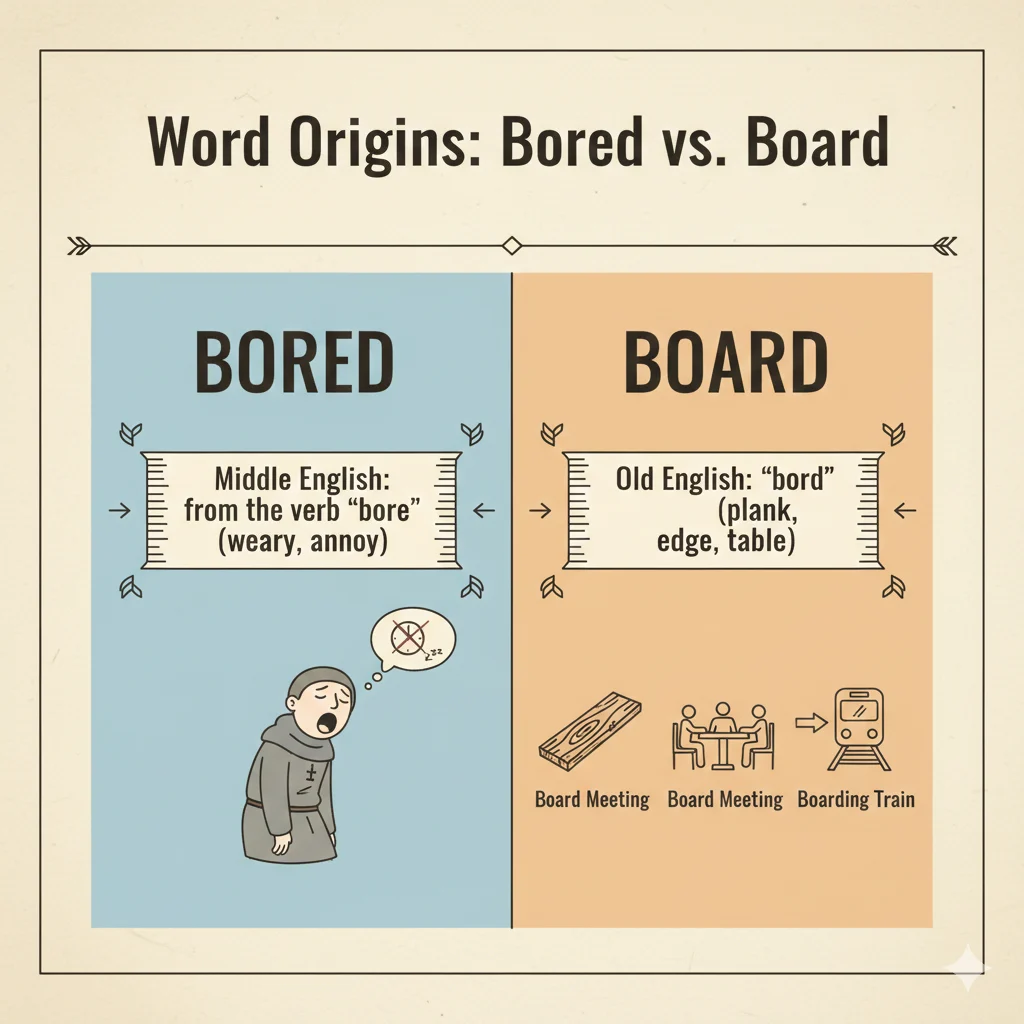
Board originates from Old English bord, meaning “plank, flat surface, or table.” Over time, its usage expanded to include:
- Governing group: e.g., board of directors
- Meals/room provision: e.g., room and board
- Traveling: e.g., boarding a plane
Spelling difference explanation:
- Bored is derived from a verb (bore → bored).
- Board remains a noun with multiple meanings.
Fun fact:
The homophone confusion exists because English borrowed words from multiple languages with overlapping sounds, but different spellings and meanings.
British English vs American English Spelling
Interestingly, bored vs board spellings are the same in British and American English. However, some derivatives differ.
| Word/Term | British English | American English | Notes |
|---|---|---|---|
| Bored | bored | bored | Same in both |
| Board (noun) | board | board | Same in both |
| Board (verb – travel) | board | board | Same in both |
| Boring (adjective) | boring | boring | Same in both |
Key points:
- While spelling is identical, usage can vary in idioms or common phrases.
- British English may use “on the board” more in professional contexts, while American English often prefers “join the board”.
Which Spelling Should You Use?
Choosing between bored and board depends on context and audience:
- Bored → use when expressing emotions:
- I am bored with this lecture.
- She felt bored during the movie.
- Board → use when referring to objects, groups, or boarding:
- He painted the board.
- She joined the school board.
- We will board the train at 9 AM.
- Global writing tip:
- If writing for US audiences, follow American conventions.
- For UK/Commonwealth audiences, spelling is the same, but phrasing may differ.
- For mixed/global audiences, focus on context clarity over strict regional usage.
Common Mistakes with Bored vs Board
| Mistake | Correct Usage | Explanation |
|---|---|---|
| I am board of this class. | I am bored of this class. | Expressing feeling, not object |
| He nailed the bored to the wall. | He nailed the board to the wall. | Refers to physical object |
| Let’s play bored games tonight. | Let’s play board games tonight. | Games are on a board, not a feeling |
| She is on the bored of directors. | She is on the board of directors. | Group of people, not tired |
| Feeling bored or board? | Feeling bored | Correct emotional expression |
Tip: Proofreading helps catch these mistakes. Online spell-checkers may not flag them because they are real words with different meanings.
Bored vs Board in Everyday Examples
Emails
- I’m bored with the current project timeline. Could we brainstorm ideas?
- Please place the notice on the board in the meeting room.
News Headlines
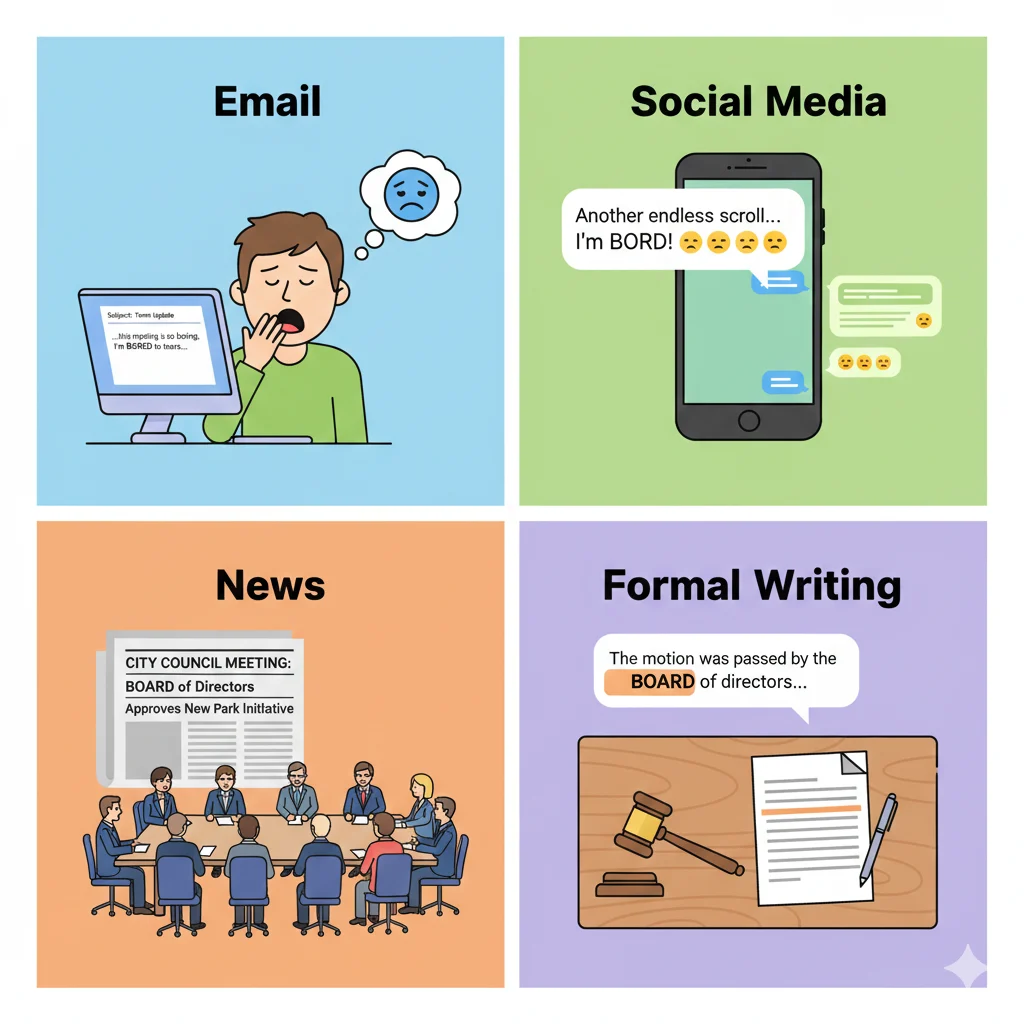
- The board approved a new environmental policy.
- Students are increasingly bored with traditional lectures.
Social Media
- Feeling so bored on this rainy day! #BoredVsBoard
- Board vs bored meme circulating on TikTok is hilarious 😆
Formal Writing
- The board of trustees convened yesterday to review the budget.
- Being bored during research can reduce productivity; breaks are recommended.
Bored vs Board – Google Trends & Usage Data
- Search popularity: Peaks among students, teachers, and English learners.
- High traffic regions: US, UK, India, Canada, and Australia.
- Related queries:
- board bored homophones in sentences
- being bored meaning
- how to spell board games
- bored vs board pronunciation
- board vs bored meme
Keyword variations side-by-side:
| Keyword Variation | Search Intent | Notes |
|---|---|---|
| bored vs board | Definition/confusion | Primary keyword |
| bored vs board meaning | Clarification of meaning | Secondary keyword |
| bored vs board pronunciation | How to pronounce | LSI keyword |
| board bored homophones in sentences | Sentence examples | LSI keyword |
| board vs bored meme | Fun content | LSI keyword |
| being bored meaning | Related adjective explanation | LSI keyword |
| how to spell board games | Contextual usage | LSI keyword |
| is it board or bored | Quick answer | LSI keyword |
| what is the difference between board and boring | Misused forms | LSI keyword |
Tips for Remembering Bored vs Board
- Mnemonic for Bored: “Bored = Body tired of something.”
- Mnemonic for Board: “Board = Board of wood, Board of people, Board a vehicle.”
- Always check the context in your sentence before choosing.
- Read aloud; sometimes hearing the sentence helps you identify the correct word.
Bored vs Board in Common Phrases
| Phrase | Correct Word | Example |
|---|---|---|
| Feeling ___ during class | bored | I am bored during math class. |
| Join the ___ of directors | board | She joined the board of directors. |
| Play ___ games tonight | board | Let’s play board games tonight. |
| The lecture was ___ | boring | The lecture was boring, not bored. |
| Nail the ___ to the wall | board | He nailed the board to the wall. |
Bored vs Board – Summary
- Bored → feeling uninterested or weary.
- Board → physical object, governing group, or act of boarding.
- Pronunciation is identical; context is everything.
- Misuse can appear in emails, essays, or casual messages.
- Both British and American English use the same spelling.
- LSI keywords like “board bored homophones in sentences”, “being bored meaning”, and “board vs bored meme” naturally reinforce understanding.
Conclusion
Mastering bored vs board ensures clarity in writing and speech. While they sound the same, their meanings couldn’t be more different: bored expresses feelings of disinterest, while board refers to objects, groups, or boarding actions. Confusing the two is common, especially in casual texts or emails, but context is your key guide.
Use this article to check common mistakes, understand pronunciation, and apply correct usage in formal, academic, or social contexts. Remember phrases like board games, board of directors, and being bored. Proofread your messages to avoid embarrassing errors like “I am board” when you meant “I am bored”. By integrating these tips into your writing, you’ll write with confidence, impress readers, and never mix up these homophones again. Share this guide with friends, colleagues, or students who struggle with bored vs board, and enjoy accurate English every day!

Mark Twain was an American author celebrated for his humor, sharp social commentary, and adventurous stories that captured the spirit and voice of everyday life.