Confused between “cataloguing” and “cataloging”? You’re not alone. Many writers wonder which spelling is correct and whether there’s any real difference. The simple answer is: both are correct, but they are used in different versions of English.
“Cataloging” is the preferred spelling in American English, while “cataloguing” is commonly used in British English and other regions that follow British spelling rules. Both words mean the same thing — the process of organizing, listing, or recording items systematically, such as books in a library or products in a store.
Understanding this spelling difference is important for academic writing, professional documents, and SEO content, especially if you’re targeting a specific audience. Using the correct regional spelling helps your writing look polished and accurate.
In this guide, we’ll break down the differences, examples, and when to use each form confidently. ✨
Cataloguing vs Cataloging
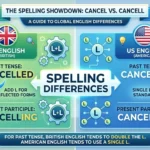
Both cataloguing and cataloging are correct spellings of the same term, which refers to the process of systematically organizing, listing, or classifying items. The difference lies in regional spelling:
- Cataloguing → British English
- Cataloging → American English
Examples:
- UK: “The librarian is cataloguing rare manuscripts.”
- US: “The librarian is cataloging rare manuscripts.”
Meaning:
Both spellings mean the same thing: creating an organized record of items, whether in libraries, offices, museums, or online inventories. The term can also extend to digital catalogs, where data or products are organized for easy access.
The Origin of Cataloguing vs Cataloging
The word catalogue comes from the Greek word katalogos, meaning “a list” or “register.” Over time, it passed into Latin as catalogus and Old French before entering English in the 14th century.
- British English retained the spelling catalogue, keeping the “ue” ending.
- American English simplified the spelling in the 19th century, largely due to Noah Webster, who preferred simplified forms in American writing.
Historical Timeline:
| Year | Event |
|---|---|
| 4th century BC | Greek term katalogos used for lists |
| 14th century | Entered English as catalogue via French |
| 19th century | American English simplified to catalog |
| 20th century | British English continued to use catalogue in formal writing |
Key point: The double “u” in cataloguing exists in British English because when adding -ing, the original “ue” is retained. American English, by contrast, removes the “u” for simplicity.
British English vs American English Spelling
Spelling differences between British and American English can seem minor but affect perception, especially in professional or academic writing.
| British English | American English | Example Sentence |
|---|---|---|
| Catalogue | Catalog | “The library added a new catalogue/catalog of books.” |
| Cataloguing | Cataloging | “She is cataloguing/cataloging historical manuscripts.” |
| Colour | Color | “I love the colour/color of this painting.” |
| Organise | Organize | “We need to organise/organize these files.” |
| Travelling | Traveling | “He is travelling/traveling to the US.” |
| Authorise | Authorize | “The manager will authorise/authorize the payment.” |
| Theatre | Theater | “The play was shown at the local theatre/theater.” |
Understanding the Rule:
- British English keeps -ue endings and often doubles consonants when adding suffixes.
- American English simplifies the spelling, removing extra letters.
For example:
- British: cataloguing → keeping “ue”
- American: cataloging → dropping “u”
This pattern is consistent in other words like travelling/traveling, colour/color, and authorise/authorize.
Which Spelling Should You Use?
Choosing the right spelling depends on your audience and context.
🇺🇸 American Audience
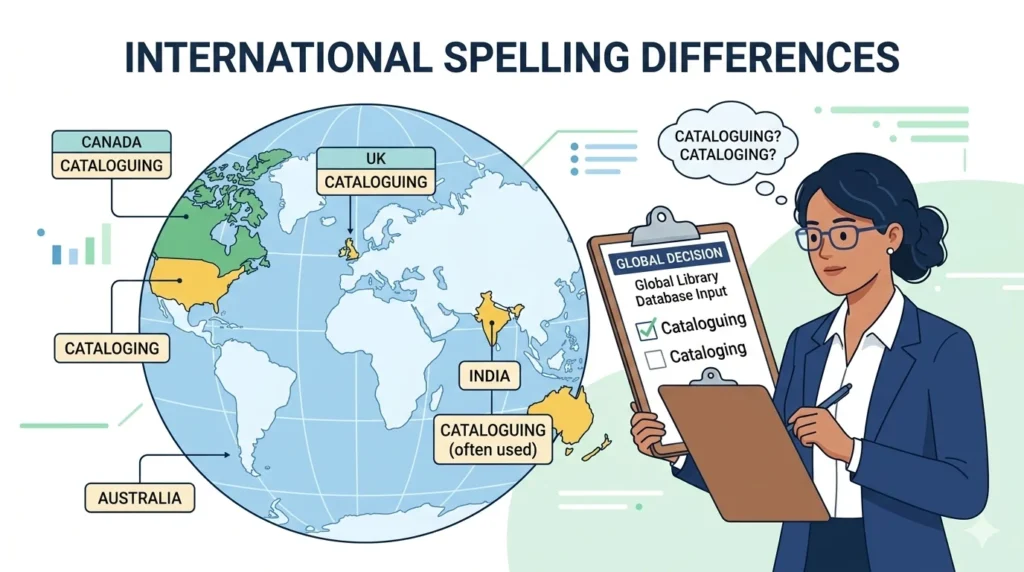
- Use cataloging in writing for American readers.
- Example: “Our company is cataloging all spring products for the online store.”
🇬🇧 British and Commonwealth Audience
- Use cataloguing for British, Australian, Canadian, and Indian readers.
- Example: “The archivist is cataloguing historical documents in the library.”
🌍 Global Audience
- Pick one spelling and use it consistently throughout your writing.
- Consistency ensures professionalism and avoids confusion.
Practical Tip: When writing for an international audience, you can include both forms at least once in parentheses for clarity:
- “The librarian is cataloguing (cataloging) new archival items.”
Common Mistakes with Cataloguing vs Cataloging
Understanding common mistakes helps you avoid errors in writing and professional documents.
- Mixing spellings in one text
❌ Example: “We are cataloguing new books and cataloging digital products.”
✔ Solution: Stick to one version. - Using American spelling in British contexts
❌ Example: “She is cataloging rare manuscripts at Oxford.”
✔ Solution: Use cataloguing. - Confusing catalogues with brochures
❌ Example: “The brochure includes all our products in a catalog.”
✔ Solution: A catalog is a structured listing; a brochure is promotional. - Typos like catalogingg or catalogueing
✔ Always double-check spelling. - Confusing with ordinal mistakes like “13rd”
✔ Correct form is 13th.
Cataloguing vs Cataloging in Everyday Life
1. Emails
- US: “We are cataloging all new inventory for the website.”
- UK: “We are cataloguing archival letters from the 18th century.”
2. News Articles
- “Libraries are cataloguing rare manuscripts to preserve cultural heritage.”
- “Retailers are cataloging spring products for online sales.”
3. Social Media
- “Busy cataloguing my vintage records today! #LibraryLife”
- “Cataloging all our new products for the eCommerce store. #InventoryDay”
4. Formal Writing
- Academic: “The process of cataloguing ensures systematic classification of library resources.”
- Business: “Cataloging product SKUs improves inventory management efficiency.”
5. Digital Catalogs
- Online retailers use cataloging tools to organize products with descriptions, images, and stock levels.
- Museums and archives use cataloguing software to maintain detailed records of artifacts.
Cataloguing vs Cataloging – Popularity by Region
Search patterns indicate:
- Cataloging dominates in the United States.
- Cataloguing is more common in the United Kingdom, Australia, Canada, India, and other Commonwealth countries.
Related Searches:

- Library cataloguing vs cataloging
- Cataloguing vs cataloging PDF
- Cataloguing definition
- Catalog vs brochure
- Cataloguing spelling
Including these related terms helps understand how people encounter and use the word in daily life.
Comparison Table – Keyword Variations
| Variation | Region | Correct? | Notes |
|---|---|---|---|
| Cataloguing | UK/Commonwealth | ✅ | Academic, libraries, archives |
| Cataloging | US | ✅ | Business, eCommerce, digital platforms |
| Catalogueing | ❌ | ❌ | Typo |
| Catalogingg | ❌ | ❌ | Typo |
| Catalog | US/UK | ✅ | Noun form (list of items) |
| Catalogue | UK/Commonwealth | ✅ | Noun form |
Examples in Context
Academic Writing
- UK: “Cataloguing manuscripts is essential to preserve historical records.”
- US: “Cataloging manuscripts ensures they are properly recorded and accessible.”
Retail and Business
- US: “The team is cataloging new arrivals in the inventory system.”
- UK: “The staff is cataloguing new merchandise for the spring season.”
Government and Archival Work
- UK: “National archives are cataloguing centuries-old documents for public access.”
- US: “The agency is cataloging federal records for digital preservation.”
Everyday Tasks
- Cataloguing your personal book collection.
- Cataloging photos and files on your computer for easy retrieval.
People Also Ask
Is it cataloguing or cataloging?
Both are correct. The choice depends on whether you are using British or American English.
What is the difference between catalog and catalog?
There is no difference in meaning; it is purely a matter of spelling.
What is catalogue and cataloguing?
- Catalogue: The list of items.
- Cataloguing: The act of creating and organizing that list.
How do you spell cataloguing in the UK?
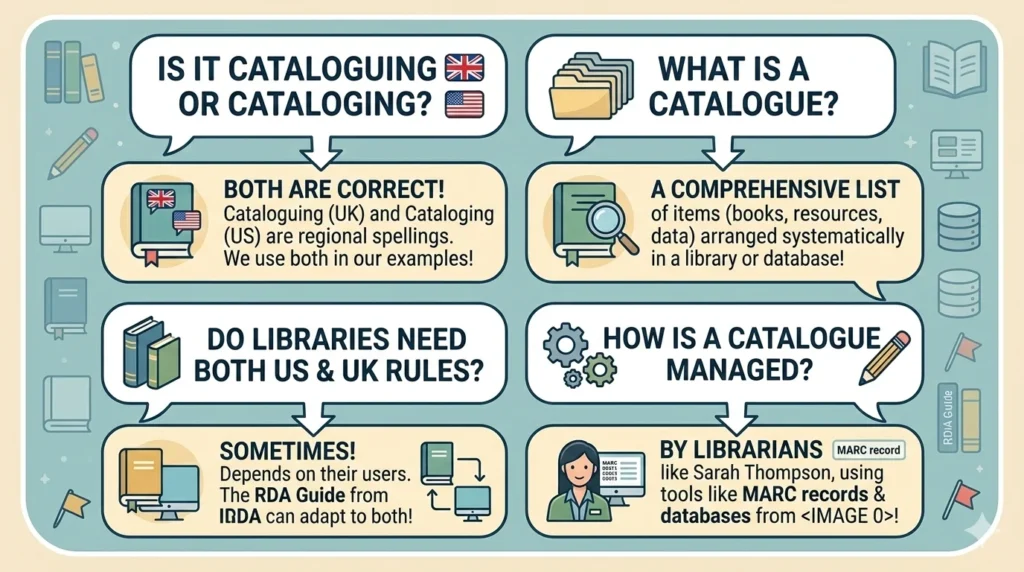
It is spelled cataloguing with “ue” before adding “-ing.”
Is cataloging used globally?
Yes, mostly in American English contexts like eCommerce, libraries in the US, and professional documents.
Practical Tips for Consistency
- Pick one form for your document or website.
- Double-check regional conventions if writing for a specific audience.
- Use parentheses to introduce the alternate form if your audience is mixed:
- Example: “The library is cataloguing (cataloging) new materials this week.”
- Review your work for typos, especially when adding suffixes like -ing.
- Be consistent with related words, such as catalogue/catalog for nouns.
Conclusion
The choice between cataloguing and cataloging is not about correctness—they are both correct. The difference is regional: British English prefers cataloguing, while American English favors cataloging. Both refer to the process of systematically organizing, listing, or classifying items, whether in libraries, offices, museums, or online inventories.
Just as understanding the correct form of 13th instead of “13rd” matters, choosing the right spelling ensures clarity and professionalism. By recognizing the differences, using consistent spelling, and understanding historical and regional context, you can write with confidence for any audience.
From academic research to business inventories and personal collections, the ability to use cataloguing or cataloging accurately improves readability, understanding, and the credibility of your work. No matter the context, clarity and consistency are key to effective communication.

Jane Austen was an English novelist famed for her sharp wit and timeless stories of love, class, and society, capturing human nature with elegance and humor.