English grammar can sometimes be confusing, especially when it comes to plural forms. A common question many writers, students, and language learners ask is “deers vs deer – which one is correct?” At first glance, it seems logical to add “s” to make a plural noun, just like we do with cats, cars, or books. However, English also contains a number of words that do not follow the usual pattern.
The deers vs deer question appears frequently because people want to understand the correct plural form, how to use it in sentences, and whether “deers” is ever acceptable. It also connects with other common questions such as Is it two deer or deers?, Is deer zero plural?, and what is the plural form of deer and sheep? Another related confusion comes from pronunciation because deer and dear homophones sound exactly the same but have completely different meanings.
In this guide, you will learn the rule behind deers vs deer, the origin of the word, and how it is used in everyday communication. You will also see clear examples, comparison tables, and explanations that help you avoid common mistakes when writing or speaking English.
Deers vs Deer
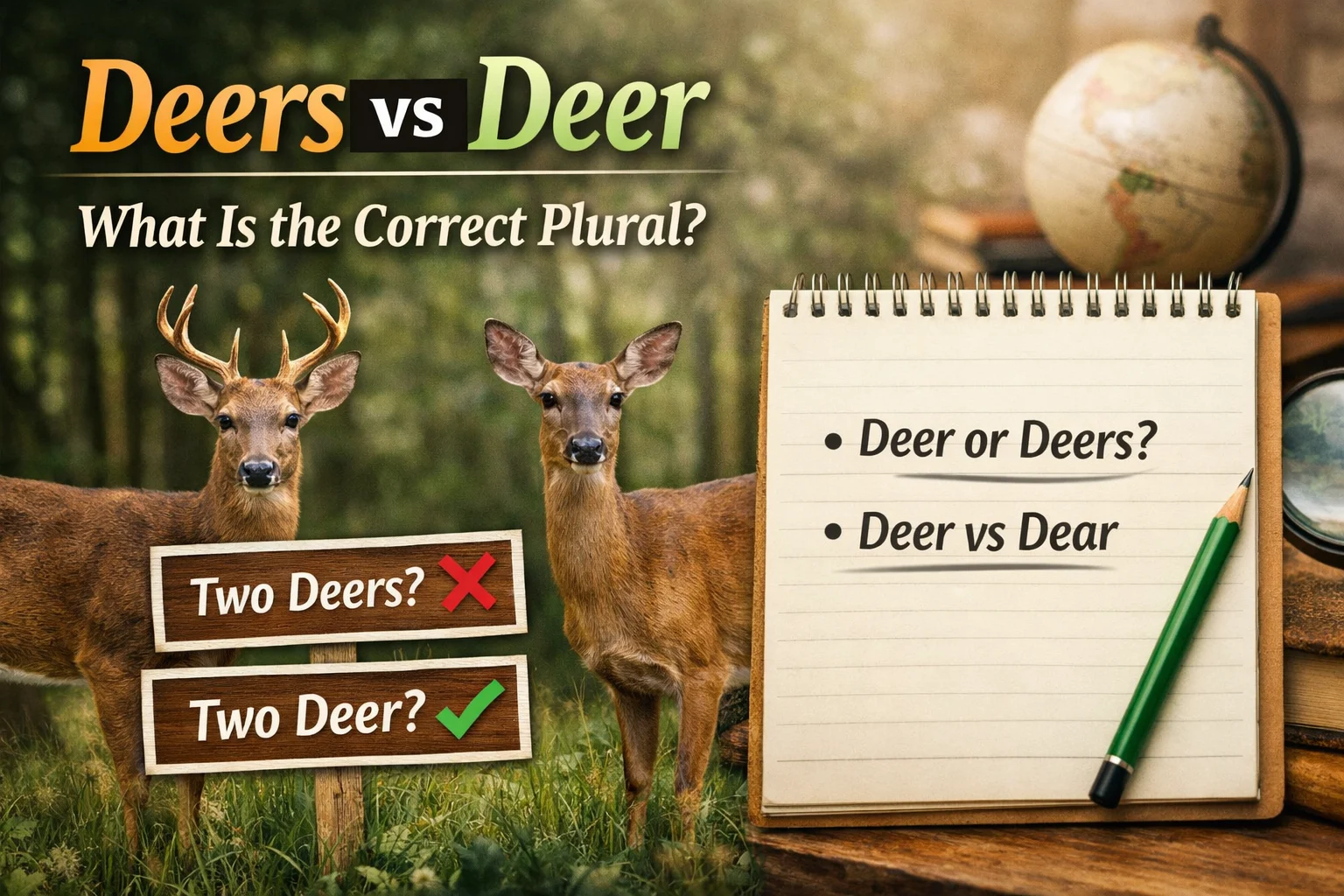
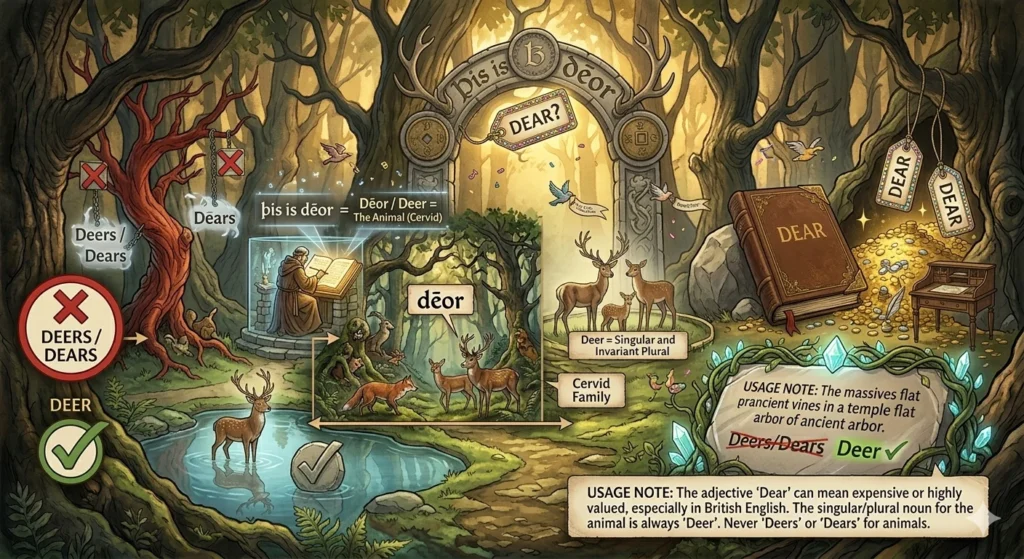
The correct plural form is deer, not deers.
The word deer belongs to a special group of nouns known as zero-plural nouns, which means the singular and plural forms stay the same.
Examples
- I saw one deer in the forest.
- We spotted five deer near the river.
- A group of deer crossed the road at night.
Using deers in everyday English is usually considered incorrect.
However, in rare scientific discussions, the word deers may appear when referring to different species of deer.
Example:
Researchers studied several deer species, sometimes called different deers in biological classification.
For normal communication, the correct form in the deers vs deer debate is simply deer.
The Origin of Deers vs Deer
To understand the deers vs deer rule, it helps to look at the history of the word.
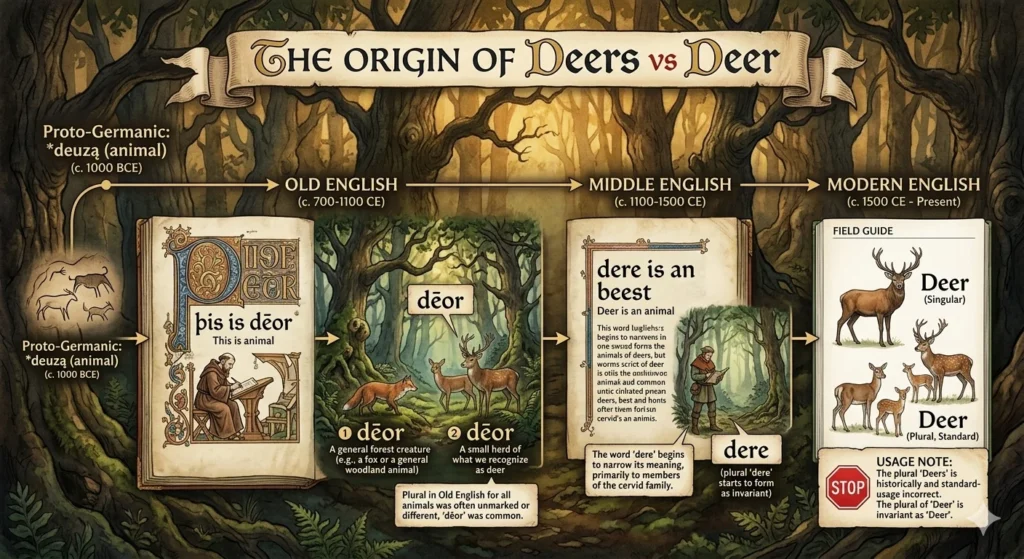
The word deer comes from the Old English word “dēor.” In early English, this word referred to any wild animal, not just the animal we call a deer today. Over time, the meaning became more specific and began referring only to animals such as red deer, roe deer, and white-tailed deer.
Because the word is very old, it kept its original plural structure instead of adopting the modern –s plural ending.
This pattern also appears in other English nouns.
| Singular | Plural |
|---|---|
| Deer | Deer |
| Sheep | Sheep |
| Fish | Fish |
This grammatical pattern is called zero plural, meaning the plural form does not change.
So when people search “deers vs deer”, the confusion happens because modern English normally adds –s, but some historical words follow older rules.
British English vs American English Spelling
Some English words have different spellings depending on the region, but deers vs deer is not one of them.
Both British English and American English use the same plural form.
| Usage | British English | American English |
|---|---|---|
| Singular | deer | deer |
| Plural | deer | deer |
| Incorrect form | deers | deers |
Example sentences
British usage
A group of deer was seen crossing the countryside road.
American usage
Several deer were spotted near the national park.
In both regions, the correct answer to deers vs deer remains the same.
Which Spelling Should You Use?
When writing for any audience, the safest and most accurate choice is deer.
Recommended usage
Use deer in:
- articles and blogs
- academic writing
- emails and messages
- social media posts
- formal documents
The word deers should only appear in rare scientific discussions when talking about multiple species.
Example:
Biologists studied different deer species across Asia and Europe.
For everyday English, the correct choice in the deers vs deer question is always deer.
Common Mistakes with Deers vs Deer
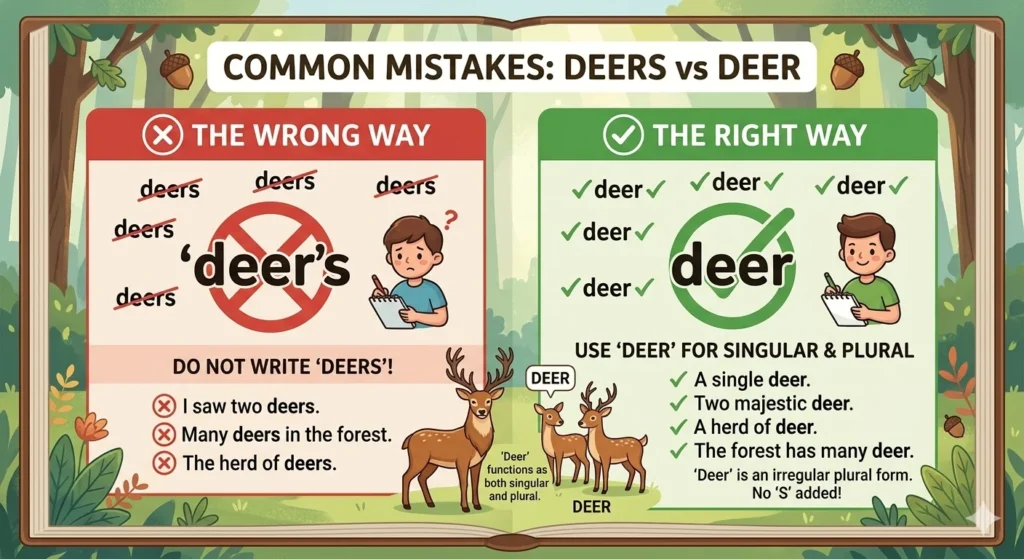
Mistake 1: Adding “s” to make the plural
Incorrect: I saw three deers in the forest.
Correct: I saw three deer in the forest.
Mistake 2: Confusing deer with dear
Many learners confuse deer with dear because they sound the same.
These words are known as dear and deer homophones.
- Deer → an animal
- Dear → beloved person or something expensive
Example sentences:
- The deer ran into the woods.
- My dear friend sent me a letter.
Deer and Dear Pronunciation
The pronunciation of deer and dear is identical in English. Both are pronounced as:
/dɪr/
Because of this, they are considered homophones, meaning words that sound the same but have different meanings.
Deer and Dear Meaning
Deer
A grazing animal with hooves that lives in forests and grasslands.
Example:
A deer was standing near the lake.
Dear
A word used to express affection or describe something expensive.
Example:
This watch is very dear (expensive).
Example homophone sentence:
Dear, look at that beautiful deer near the trees.
Deer Plural and Similar Nouns
The plural form of deer follows the same rule as a few other English nouns.
Plural form of deer and sheep
| Singular | Plural | Example |
|---|---|---|
| Deer | Deer | Three deer were grazing. |
| Sheep | Sheep | Ten sheep were in the field. |
| Fish | Fish | Many fish swim in the river. |
These nouns keep the same form in singular and plural.
Deer Plural Sentence Examples
Here are clear examples showing the correct plural usage.
- Two deer crossed the road.
- Several deer were drinking water from the stream.
- Many deer live in this forest.
These examples answer the question “Is it two deer or deers?” — the correct form is two deer.
Are Deers Female?
Another common search question is “Are deers female?”
The answer is no.
The word deer refers to both male and female animals.
- Male deer → buck or stag
- Female deer → doe
Example sentence:
A doe and her young deer were walking through the meadow.
Deer or Dear – Which Means Expensive?
The word dear can also mean expensive.
Example:
This restaurant is very dear.
In this context, dear has nothing to do with the animal deer, even though the pronunciation is the same.
Deers vs Deer – Usage Around the World
Interest in the deers vs deer question appears in many English-speaking countries.
Writers from the United States, United Kingdom, Canada, Australia, and India often look for the correct plural rule because irregular nouns can be confusing.
Usage comparison
| Word Form | Meaning | Typical Usage |
|---|---|---|
| Deer | Singular animal | Correct |
| Deer | Plural animals | Correct |
| Deers | Multiple species (rare scientific use) | Very uncommon |
In everyday English, deer remains the standard plural form.
Everyday Examples of Deer in Communication
Email example
During our trip to the park, we saw several deer near the forest trail.
News example
Wildlife officials reported that dozens of deer were spotted near the highway.
Social media example
Just saw three deer while hiking this morning!
Formal writing example
The national park protects many species of wildlife, including large populations of deer.
Conclusion
The confusion around deers vs deer comes from the fact that English usually forms plural nouns by adding –s. However, some older words follow different grammar patterns. The word deer is a zero-plural noun, which means the singular and plural forms remain exactly the same. That is why we say one deer, two deer, or many deer, rather than deers.
Understanding this rule also helps clarify related questions such as Is it two deer or deers?, Is deer zero plural?, and what is the plural form of deer and sheep? Both British and American English follow the same rule, so the correct plural is always deer in standard writing.
It is also useful to remember the difference between deer and dear, which are homophones. While deer refers to the animal, dear can mean beloved or expensive. Once you understand these distinctions, the deers vs deer confusion becomes easy to solve, helping you write clearly and correctly in everyday English.

E.M. Forster was an English novelist celebrated for his insightful stories about class, connection, and humanity, blending gentle humor with deep social themes.