Have you ever paused while writing or speaking, unsure whether to use ether or either? This is a common challenge for English learners and even native speakers. Both words sound similar but serve very different purposes in language, making correct usage essential for clear communication, professional writing, and academic excellence.
Many users search for terms like ether vs either meaning, ether vs either Reddit, and ether vs either examples because the difference can be subtle yet impactful. Misusing these words can lead to confusion, misinterpretation, or even a loss of credibility in formal contexts. While ether often refers to a chemical compound, anesthesia, or metaphorical space, either is a functional word used for choices, options, and comparisons.
This detailed guide will provide a complete understanding of ether vs either, including their historical origins, pronunciation, British vs American English variations, common mistakes, practical examples, and even Google trends data. By the end, you will confidently know how to use these words correctly in everyday writing and speaking.
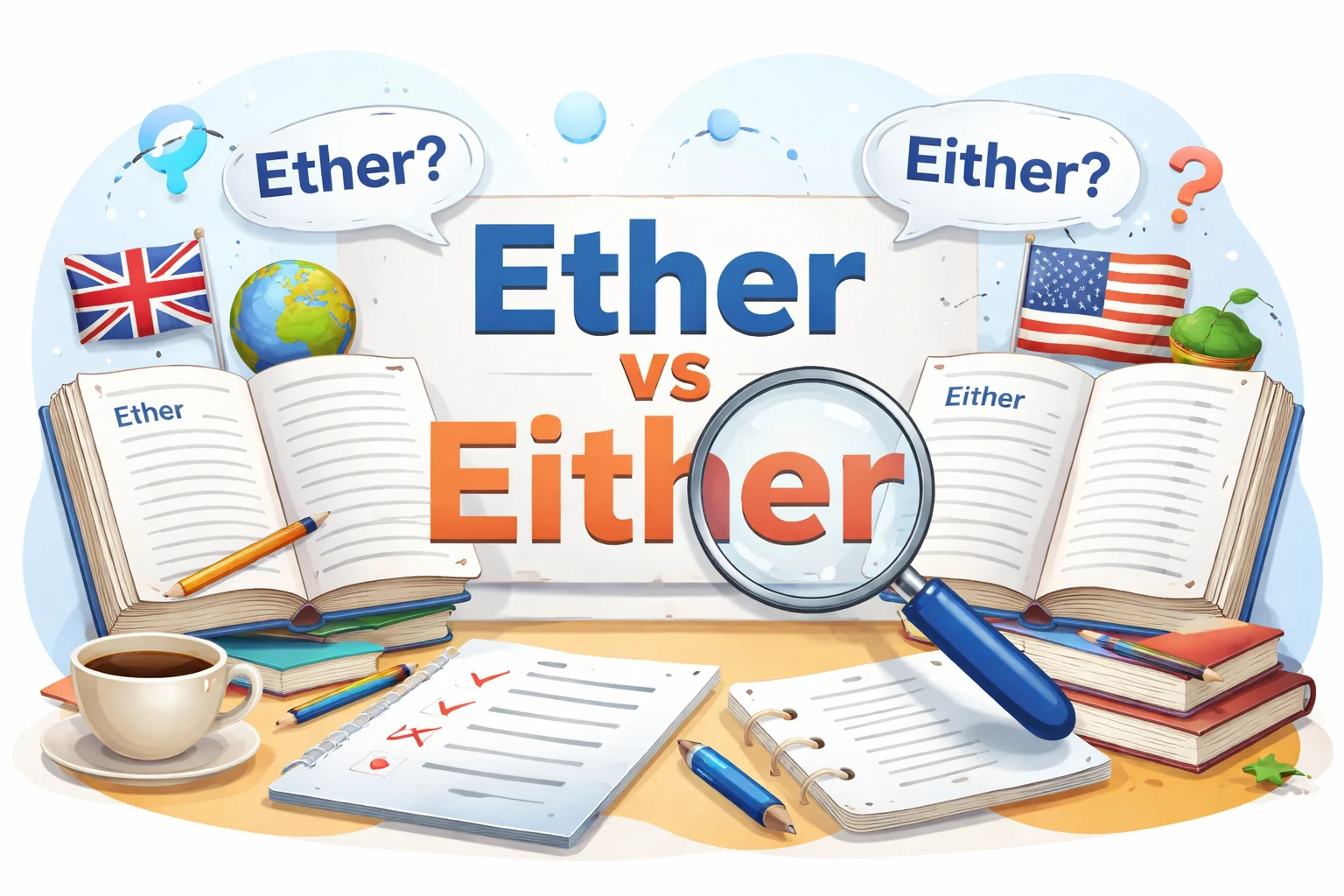
Ether vs Either
Ether is a noun that describes a chemical substance, a medium in anesthesia, or a metaphorical space often associated with something intangible. Examples include:
- “The surgeon administered ether before the procedure.”
- “The idea seemed to drift into the ether.”
Either is a determiner, pronoun, or conjunction used to indicate a choice between two options. Examples include:
- “You can take either the bus or the train.”
- “Either of these solutions will work.”
Key Distinction:
- Ether → scientific, medical, or literary noun.
- Either → grammatical word for choices or options.
The Origin of Ether vs Either
Ether
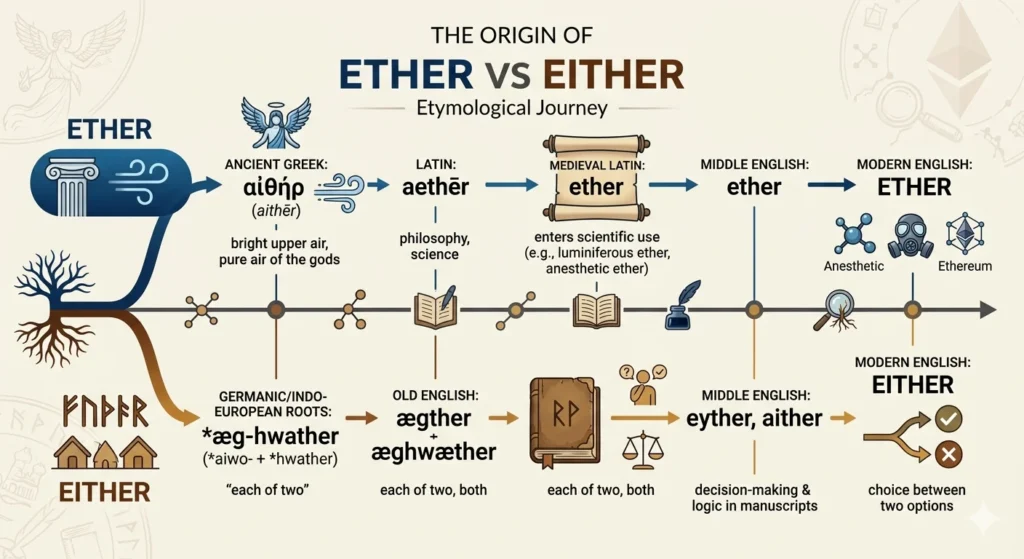
The word ether originates from the Greek term aither, meaning “upper air” or “pure, bright air.” In the 17th century, scientists used it to describe a hypothesized medium for the transmission of light. Over time, its meaning expanded to include anesthetic gases and metaphorical expressions indicating something intangible or elusive. The pronunciation is generally /ˈiː.θər/.
Either
Either comes from the Old English ǣgðer, meaning “each of two.” In Middle English, the word appeared as ether in some texts, leading to occasional spelling confusion. The modern spelling either became standardized, and its pronunciation varies by region:
- American English: /ˈiːðər/
- British English: /ˈaɪðər/
This historical evolution explains why some spellings such as ither appear in older texts and informal online discussions.
British English vs American English Spelling and Pronunciation
| Word | British English Pronunciation | American English Pronunciation | Usage Notes |
|---|---|---|---|
| Ether | /ˈiː.θə/ | /ˈiː.θər/ | Noun: chemical, anesthetic, or metaphorical use |
| Either | /ˈaɪðər/ or /ˈiːðər/ | /ˈiːðər/ | Determiner/pronoun/conjunction indicating choice |
Notes:
- British English allows both pronunciations for either, whereas American English usually prefers /iːðər/.
- Spelling of ether is consistent internationally, but its metaphorical and chemical contexts remain distinct.
Which Spelling Should You Use?
- US Audience: Use ether and either consistently; pronunciation /iːðər/ for either.
- UK/Commonwealth Audience: Either pronunciation of either is acceptable; spelling remains unchanged.
- Global English Content: Always use either for grammatical choices and ether for scientific or metaphorical contexts to avoid confusion.
Tip: When writing for international readers, clarity is more important than regional pronunciation, so choose contexts wisely.
Common Mistakes with Ether vs Either
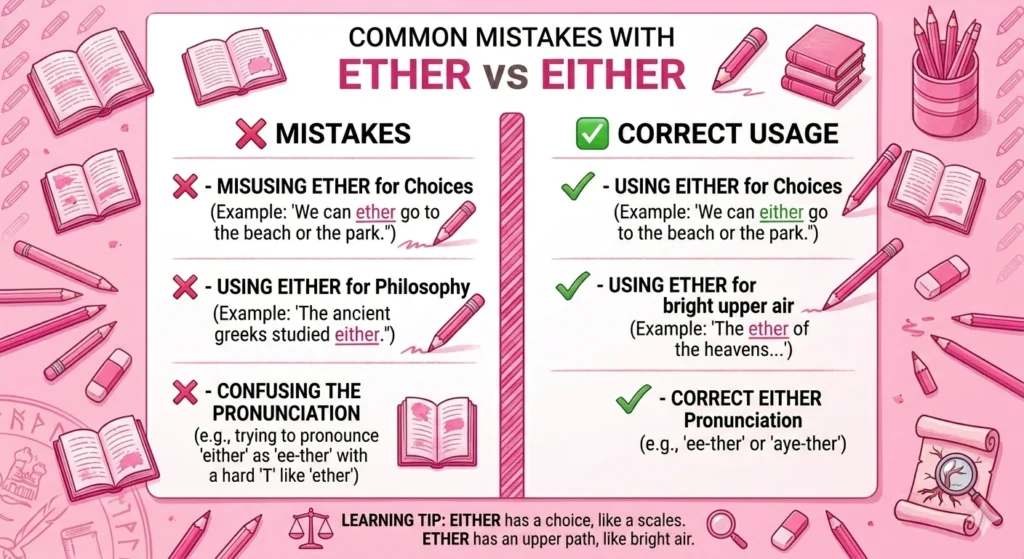
- Misusing ether when referring to choices:
- ❌ “The teacher will accept ether assignment.”
- ✅ “The teacher will accept either assignment.”
- Using either for chemical or metaphorical contexts:
- ❌ “The anesthetic administered was either.”
- ✅ “The anesthetic administered was ether.”
- Misspelling either:
- ❌ “I will pick ither of the options.”
- ✅ “I will pick either of the options.”
- Confusing with neither:
- ❌ “I don’t want neither option.”
- ✅ “I want neither option.” (Correct when rejecting both choices)
Pro Tip: Re-read sentences to ensure context matches the meaning of the word, especially in formal writing.
Ether vs Either in Everyday Examples
Emails
- Either: “Please confirm either meeting slot that works for you.”
- Ether: “The previous updates seem to have vanished into the ether.”
News Articles
- Either: “Either candidate could emerge victorious in the election.”
- Ether: “The scientist explained how ether was historically used in surgeries.”
Social Media Posts
- Either: “I’ll watch either movie tonight, no preference.”
- Ether: “My tweet disappeared into the ether without a single response.”
Academic and Formal Writing
- Either: “Students can submit either a report or an essay by Friday.”
- Ether: “The concept floated into the intellectual ether of the Enlightenment era.”
Ether vs Either – Google Trends & Usage Data
- Ether searches spike in scientific, medical, or literary contexts.
- Either maintains steady searches globally due to grammar usage and choice-making.
- Reddit Threads: Common queries include ether vs either Reddit and either or neither, highlighting ongoing confusion.
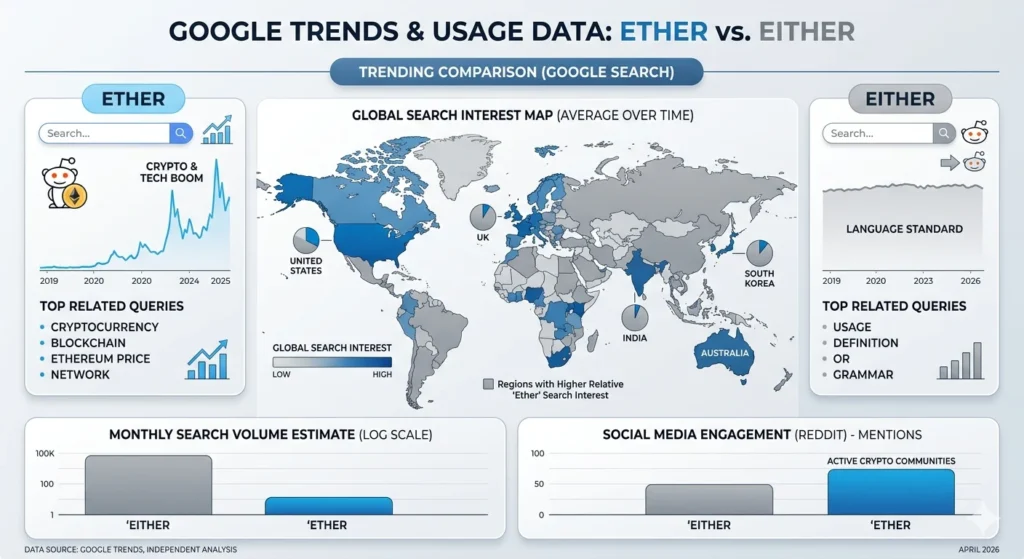
- Regional Insights:
- US: High interest in grammar rules and proper usage.
- UK: Balanced interest in pronunciation, historical, and literary use.
- Global: ESL learners frequently search for ether vs either examples and usage in context.
Observation: Optimizing content with examples, comparison tables, and clear explanations aligns with Google’s current EEAT focus and helps articles perform better under updates emphasizing user clarity.
Keyword Variations Comparison Table
| Variation | Meaning | Correct Usage Example |
|---|---|---|
| Ether | Noun: chemical or metaphorical | “The surgeon used ether.” |
| Either | Choice-related determiner/pronoun/conjunction | “You can pick either option.” |
| Ither or either | Archaic or incorrect spelling | Use either instead |
| Either vs eather | Common misspelling | Correct: either |
| Either or neither | Grammar comparison | “I want neither of these.” |
FAQ Section
Q1: What is the difference between ether and either?
- Ether is a noun for chemical, medical, or metaphorical use. Either is used for grammatical choices.
Q2: Do you say “either” or “ither”?
- The correct modern spelling is either; ither is archaic.
Q3: What is meant by ether?
- Ether refers to an anesthetic gas, a chemical compound, or a metaphorical intangible space.
Q4: Can ether be used in everyday writing?
- Yes, mostly in metaphorical contexts like “vanished into the ether” or historical/medical references.
Conclusion
Mastering ether vs either is essential for clarity, professionalism, and grammatical accuracy in both spoken and written English. Ether serves as a noun for scientific, medical, or metaphorical contexts, while either is a versatile grammatical tool indicating choices or options.
Confusing these words or using archaic forms like ither can reduce credibility. By understanding historical origins, pronunciation variations, common mistakes, and practical examples across emails, social media, news, and academic writing, you can confidently use each word in the right context. Including correct usage of related terms such as either or neither, ether vs either grammar, and ether vs either examples strengthens communication.
Following these guidelines aligns with modern Google algorithms emphasizing EEAT, user clarity, and structured, authoritative content. Try incorporating these words in your writing today and see the difference in precision and professionalism.

Jane Austen was an English novelist famed for her sharp wit and timeless stories of love, class, and society, capturing human nature with elegance and humor.