In daily life, we ask questions like “Are you faring well?”, compare progress using “Faring better than me”, or talk about technical objects like a motorcycle fairing. Mixing them up can be embarrassing or confusing. This guide will explain faring meaning, what does fairing mean, their origins, spelling differences, usage examples, common mistakes, and tips for choosing the right word for your audience. By the end, you’ll confidently know when to use faring and when fairing is correct.
Faring vs Fairing
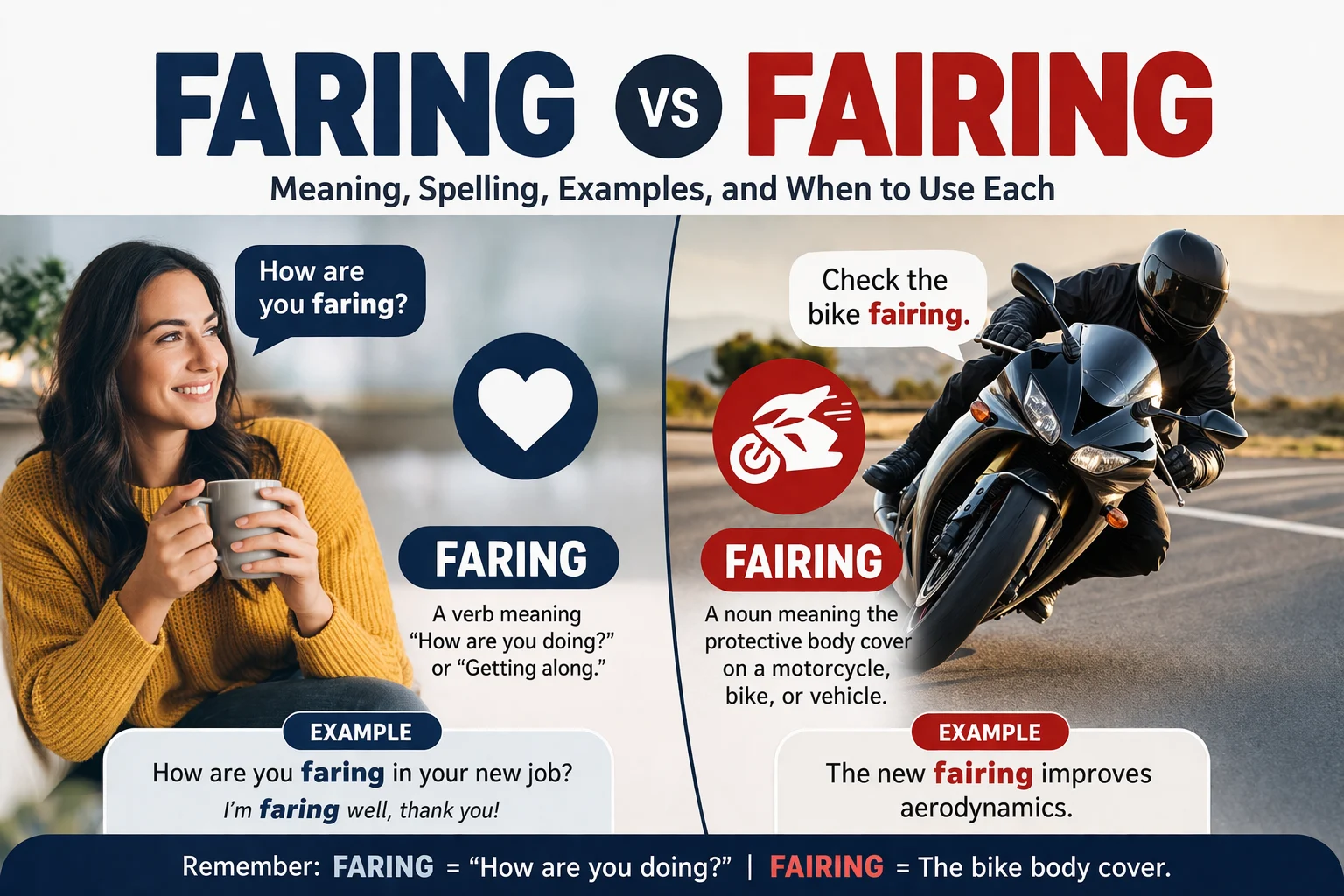
Faring is a verb that talks about how someone is doing, their progress, or wellbeing. Examples include:
- “How are you faring?”
- “She is faring well in her new job.”
- “I am faring better than last month.”
Fairing, however, is a noun used in vehicles or aerospace. It describes a protective covering designed to reduce air drag or protect parts. Examples include:
- “The motorcycle fairing protects the engine.”
- “The rocket’s fairing separated after launch.”
- “The airplane fairing must be checked before takeoff.”
✅ Tip: If you’re asking about progress, use faring. If referring to an object, use fairing.
The Origin of Faring vs Fairing
Faring comes from Old English faran, meaning “to travel or go.” Over centuries, it evolved to mean “how someone is doing or getting along” in modern English. Expressions like “How are you faring?” or “Faring well meaning” are common in both casual and formal writing.
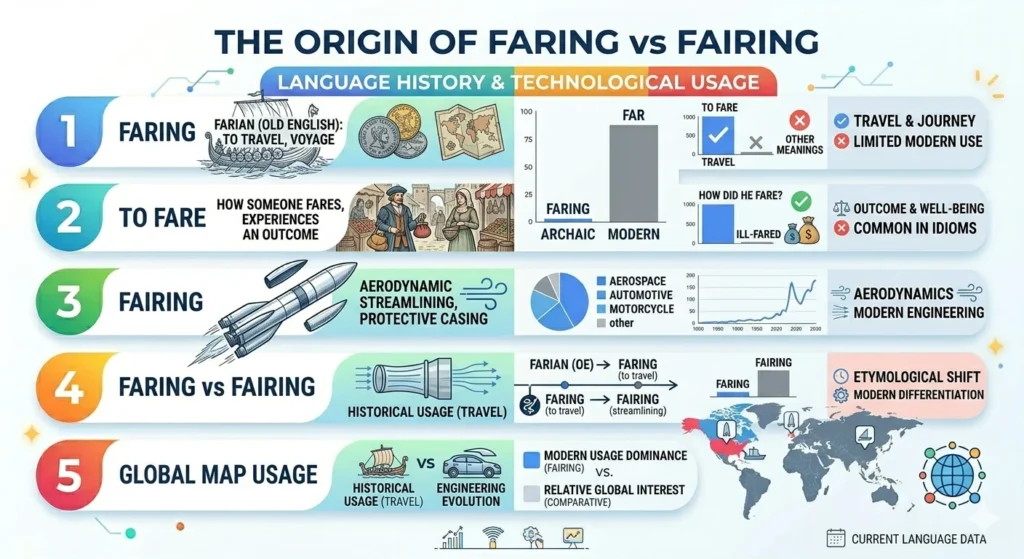
Fairing comes from the word fair, meaning smooth or beautiful. Over time, it referred to smooth, protective coverings on vehicles, motorcycles, airplanes, and rockets. This is why fairing always points to a physical object rather than progress.
The confusion exists because English has many homophones—words that sound the same but have different meanings and spellings.
British English vs American English Spelling
Interestingly, both faring and fairing are spelled the same in British and American English. The difference lies in meaning, not region.
| Word | Meaning | British Example | American Example |
|---|---|---|---|
| Faring | Progress, wellbeing | “How are you faring?” | “She is faring well in school.” |
| Fairing | Protective cover on vehicles | “The bike’s fairing is damaged” | “The airplane fairing detached.” |
Even though spelling is identical, context is key. For progress, always use faring. For technical objects, always use fairing.
Which Spelling Should You Use?
- Use “faring” → Health, success, progress, or wellbeing.
- Use “fairing” → Mechanical, vehicles, motorcycles, planes, or rockets.
Audience-based advice:
- US & UK/Commonwealth → Stick to context; don’t rely on spelling rules.
- Global audiences → Faring is more common in conversational English; fairing appears in technical contexts.
✅ Quick rule: Ask yourself—Am I talking about progress or a physical object?
Common Mistakes with Faring vs Fairing
| Mistake | Correct Form |
|---|---|
| “How are you fairing?” | “How are you faring?” |
| “She is fairing well.” | “She is faring well.” |
| “Motorcycle faring broken.” | “Motorcycle fairing broken.” |
| “Not fairing well meaning?” | “Not faring well meaning?” |
| “Is it fairing better than me?” | “Is it faring better than me?” |
Many people make these mistakes because they sound the same. The golden rule: Progress → faring, Object → fairing.
Faring vs Fairing in Everyday Life
Here’s how these words appear in real-life situations:
- Emails:
- “I hope you are faring well during these busy times.”
- “We are faring better than expected in our project progress.”
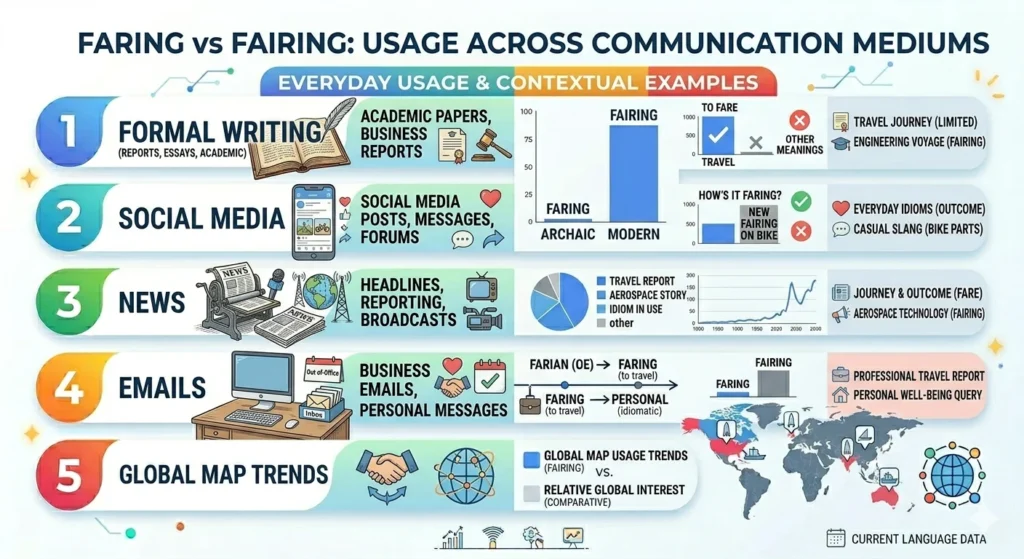
- News:
- “The local economy is faring better than last year.”
- “Residents are not faring well after the storm.”
- Social Media:
- “Not faring well after my exams 😅”
- “I’m faring better than I thought!”
- Formal Writing:
- “The spacecraft’s fairing protects sensitive instruments during launch.”
- “The motorcycle fairing reduces air resistance and improves stability.”
Using correct context ensures clarity in writing and speaking.
Faring vs Fairing – Google Trends & Usage
Google Trends shows:
- Faring well meaning → highly searched in the US and UK
- How are you faring answer → spikes during health crises
- Fairing → popular in automotive, aerospace, and engineering searches
| Keyword Variation | Popularity (Global) |
|---|---|
| Faring well meaning | High |
| How are you faring answer | Medium |
| Faring better than me | Low |
| What does fairing mean | Medium |
| Is it faring well or fairing well | High |
This data helps writers and learners focus on high-demand search terms.
Faring vs Fairing – Side-by-Side Comparison
| Word | Type | Meaning / Use Case | Example Sentence |
|---|---|---|---|
| Faring | Verb | Progress / wellbeing | “She is faring well in her new role.” |
| Fairing | Noun | Protective cover / mechanical part | “The rocket’s fairing detached mid-flight.” |
This table is perfect for quick reference, especially when writing emails, reports, or social media posts.
FAQs
- Is “How are you faring” correct?
✅ Yes, it’s the correct way to ask about wellbeing. - Faring better – what does it mean?
Doing better than before or better than someone else. - Not faring well meaning?
Doing poorly or struggling in a situation. - Is it faring well or fairing well?
Always use faring well for progress; fairing well is incorrect. - What does fairing up mean?
Refers to adding or installing a protective cover, usually on vehicles or planes. - How are you faring answer – examples?
“I’m faring well, thanks!” or “Not faring so well today.” - Faring vs fairing – which is more common?
Faring in daily English, fairing in technical or mechanical writing. - Are there common mistakes with faring?
Yes, people often write “fairing well” or “faring up” incorrectly.
Tips for Remembering Faring vs Fairing
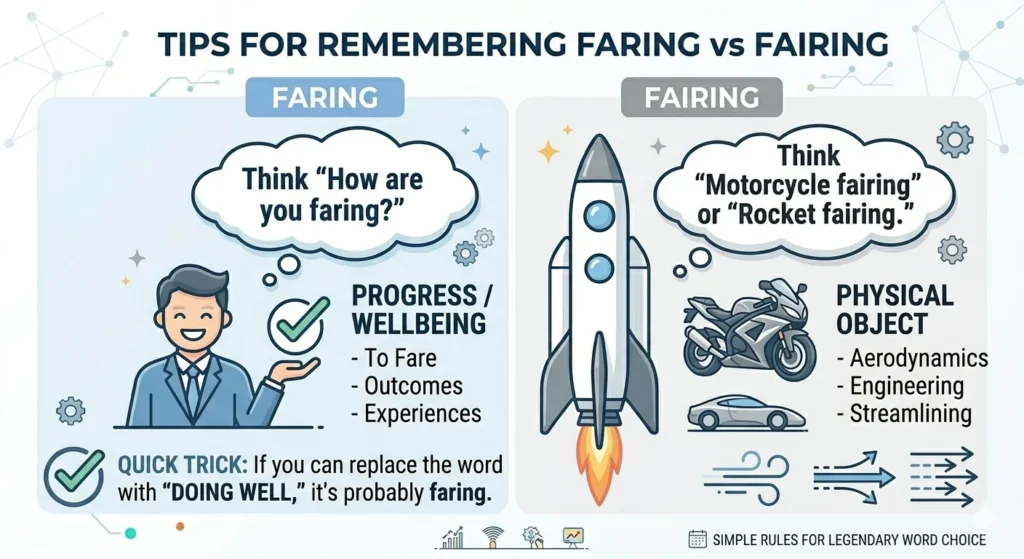
- Progress / Wellbeing → Faring → Think “How are you faring?”
- Physical Object → Fairing → Think “Motorcycle fairing” or “Rocket fairing.”
- Quick trick: If you can replace the word with “doing well,” it’s probably faring.
Call-to-Action
If you found this guide helpful, share it with friends or classmates struggling with homophones! Bookmark it for reference when writing emails, posts, or assignments.
Conclusion
Understanding faring vs fairing is crucial for clear writing and speaking. Faring relates to wellbeing, progress, and how someone is doing. Fairing is a technical term describing protective covers for vehicles, motorcycles, airplanes, or rockets.
By following context-based rules, remembering examples, and using the comparison tables and tips above, you’ll never mix them up. Whether you’re writing emails, social media posts, or formal documents, using the correct word builds clarity, professionalism, and confidence.
✅ Remember: Progress → faring; Objects → fairing. Simple, clear, and always correct.

H.E. Bates was an English author known for his vivid rural stories and warm, human-centered tales, blending gentle humor, emotion, and rich countryside life.