Many English learners search online asking the same question: “Which is correct feedback or feedbacks?”
You may have seen people write phrases like “any feedbacks,” “many feedbacks,” or “some feedbacks.” These expressions appear in emails, social media posts, and even workplace messages. Because they appear often, people start wondering if they are actually correct.
The confusion usually comes from one simple grammar rule: some nouns in English cannot be pluralized. These nouns are called uncountable nouns. The word feedback belongs to this group.
That is why many learners ask questions such as:
- Is it correct to say feedback?
- Is feedbacks correct?
- Is feedbacks a word?
- Feedback countable or uncountable?
- Is it any feedback or any feedbacks?
Understanding the correct usage of feedback is important because the word is widely used in professional communication, education, business, and online discussions.
In this guide, you will learn:
- The correct grammar rule
- Why feedback plural does not exist
- Common mistakes people make
- Real feedback examples
- How professionals use the word correctly
By the end of this article, you will clearly understand when and how to use feedback correctly in English writing and conversation.
Feedback vs Feedbacks
The correct word is feedback.
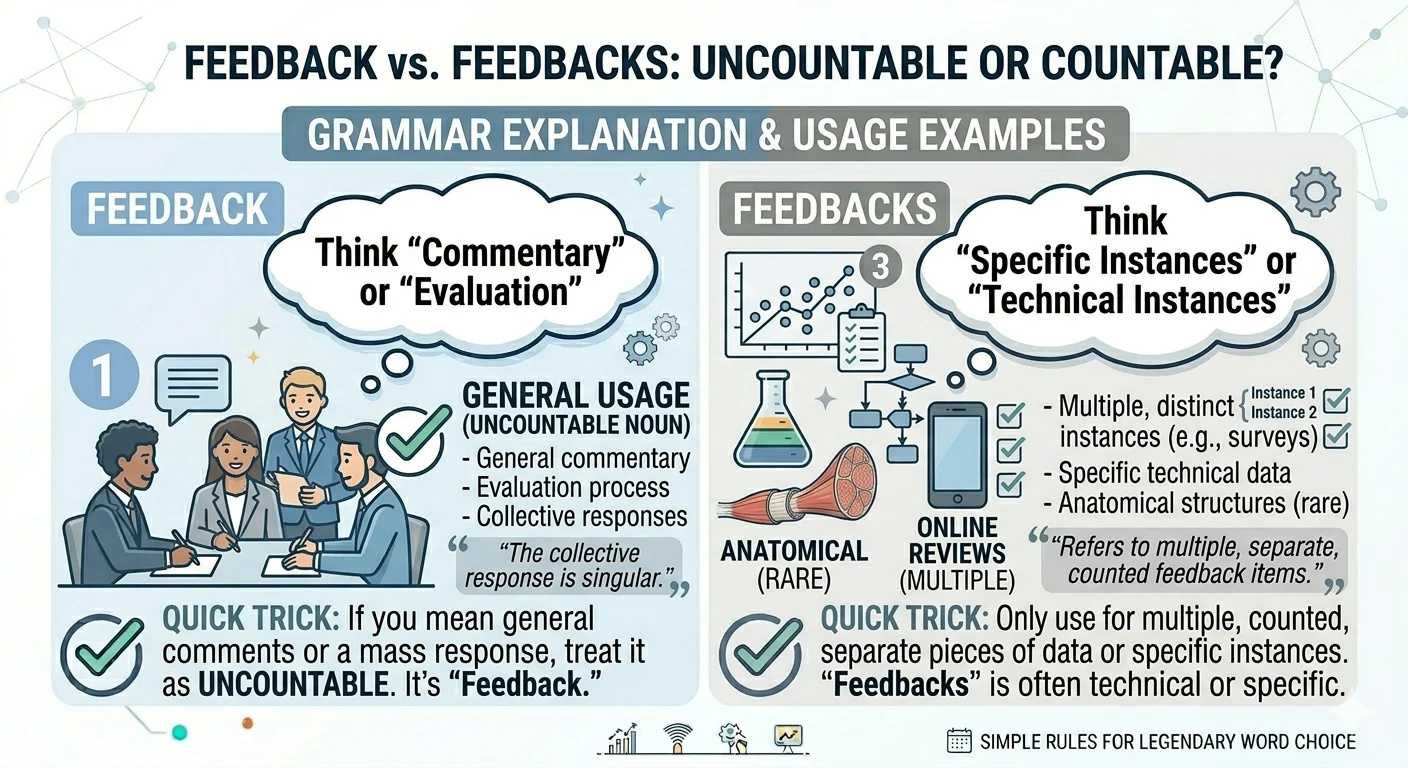
The word feedback is an uncountable noun, which means it does not normally have a plural form.
So the correct form is:
feedback
Not:
feedbacks
Correct examples
- Thank you for your feedback.
- We received a lot of feedback from users.
- Please share your feedback after the meeting.
Incorrect examples
- Thank you for your feedbacks.
- We received many feedbacks.
- Please give your feedbacks.
If you ask:
Which is correct feedback or feedbacks?
The answer is simple:
Feedback is correct.
Simple Rule
Use words like:
- some feedback
- much feedback
- a lot of feedback
Not:
- some feedbacks
- many feedbacks
Quick Grammar Table
| Phrase | Correct or Incorrect |
|---|---|
| some feedback | Correct |
| some feedbacks | Incorrect |
| many feedback | Incorrect |
| much feedback | Correct |
| any feedback | Correct |
| any feedbacks | Incorrect |
The Origin of Feedback
To understand why feedback plural is not used, we need to look at the history of the word.
The word feedback originally came from engineering and electronics.
In technical systems, feedback means information that returns to influence the system’s operation.
For example:
- A microphone produces sound.
- The sound returns to the speaker.
- The system reacts to that sound.

This loop is called a feedback loop.
Later, the word moved into business, education, and everyday communication.
Today, feedback means:
- suggestions
- opinions
- comments
- responses used to improve something
Examples include:
- customer feedback
- teacher feedback
- employee performance feedback
- product feedback
Because the word describes a general idea or process, English treats it as an uncountable noun.
Other similar uncountable nouns include:
| Word | Type |
|---|---|
| information | uncountable |
| advice | uncountable |
| knowledge | uncountable |
| feedback | uncountable |
You would never say:
- informations
- advices
- knowledges
The same rule applies to feedback.
British English vs American English Spelling
Some people think feedbacks might be used in British English, while feedback is used in American English.
However, this is not true.
Both British English and American English use the same rule.
The word feedback remains uncountable in both language varieties.
Comparison Table
| Usage | British English | American English |
|---|---|---|
| feedback | Correct | Correct |
| feedbacks | Incorrect | Incorrect |
| some feedback | Correct | Correct |
| many feedback | Incorrect | Incorrect |
| much feedback | Correct | Correct |
Example Sentences
British style:
The teacher gave helpful feedback on the essay.
American style:
The manager provided detailed feedback during the meeting.
In both cases, feedback remains singular.
Which Spelling Should You Use?
The answer depends on grammar rules, not location.
Since feedback is uncountable, the correct spelling is always:
feedback
For American audiences
Use:
Thank you for your feedback.
For British audiences
Use:
We appreciate your feedback.
For global audiences
Always use feedback.
Avoid writing feedbacks, especially in:
- professional emails
- academic papers
- reports
- business communication
Using the correct grammar helps your writing appear clear, professional, and natural.
Common Mistakes with Feedback vs Feedbacks
Many learners make similar grammar mistakes.
Let’s look at the most common ones.
Using Feedbacks
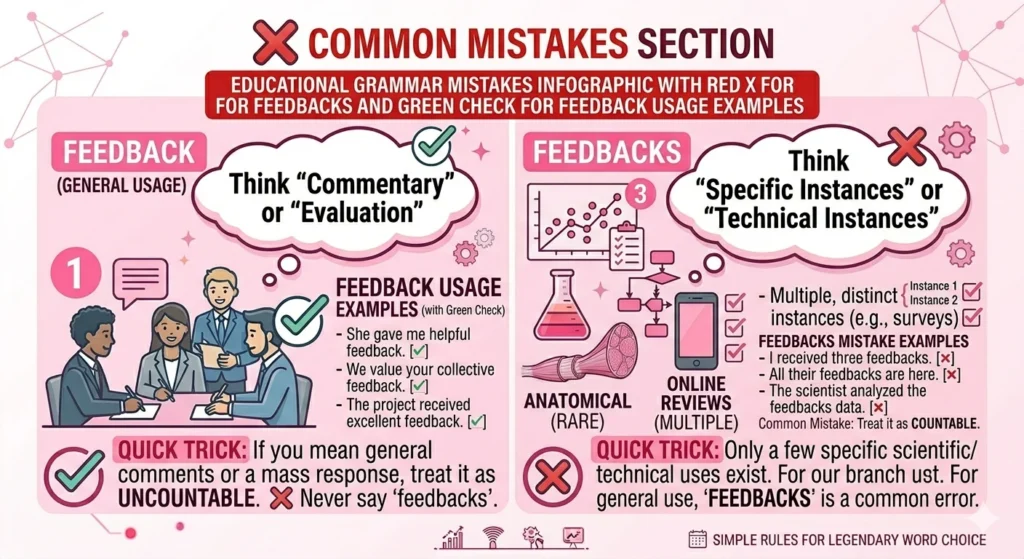
Incorrect:
I received many feedbacks from customers.
Correct:
I received a lot of feedback from customers.
Many Feedback or Much Feedback
Because feedback is uncountable, we use much, not many.
Incorrect:
many feedback
Correct:
much feedback
Example:
The company received much feedback about the new product.
Any Feedback or Any Feedbacks
Correct phrase:
any feedback
Incorrect phrase:
any feedbacks
Example:
Do you have any feedback on this design?
Some Feedback or Feedbacks
Correct:
some feedback
Incorrect:
some feedbacks
Example:
The teacher gave some feedback on the assignment.
These Feedback or This Feedback
Correct:
this feedback
Incorrect:
these feedback
Example:
This feedback will help improve the project.
Correction Table
| Incorrect Phrase | Correct Phrase |
|---|---|
| feedbacks | feedback |
| many feedback | much feedback |
| any feedbacks | any feedback |
| some feedbacks | some feedback |
| these feedback | this feedback |
Feedback in Everyday Examples
Understanding grammar is easier when you see real examples.
Here are common situations where feedback is used.
Email Example
Subject: Report Review
Hello John,
Thank you for your feedback on the report. Your suggestions helped improve the final version.
Best regards
Workplace Example
The manager gave constructive feedback to help the team improve performance.
Customer Service Example
The company collected customer feedback to improve its services.
Education Example
The teacher provided detailed feedback on the student’s essay.
Social Media Example
Thank you everyone for the amazing feedback on my new video.
News Example
Customer feedback helped the company redesign its mobile app.
Types of Feedback
The word feedback is often combined with other descriptive words.
Here are common types:
| Type | Meaning |
|---|---|
| positive feedback | praise or approval |
| negative feedback | criticism or problems |
| constructive feedback | helpful suggestions |
| customer feedback | opinions from customers |
| employee feedback | workplace performance comments |
| peer feedback | comments from colleagues |
Example:

The manager gave constructive feedback to improve the team’s communication.
Feedback vs Feedbacks – Comparison Table
| Word | Grammar Type | Correct Usage | Example |
|---|---|---|---|
| feedback | uncountable noun | correct | Thank you for your feedback |
| feedbacks | incorrect plural | incorrect | I received feedbacks |
Google Trends and Usage Data
Search engines show that many users are confused about this grammar rule.
Popular searches include:
- Which is correct feedback or feedbacks
- Is feedbacks correct
- Is feedbacks a word
- Feedback plural
- Feedback countable or uncountable
- Some feedback or feedbacks
These searches are especially common in countries where English is widely used as a second language, such as:
- India
- Pakistan
- Philippines
- Nigeria
- Indonesia

Because of this confusion, articles explaining this rule often perform well in search results.
Providing clear examples and simple explanations helps readers quickly understand the correct usage.
Expert Grammar Tip
Linguists classify feedback as a mass noun, also known as an uncountable noun.
Mass nouns describe things that cannot be counted individually.
Examples include:
- information
- advice
- knowledge
- equipment
- feedback
Because these nouns represent ideas or concepts rather than separate items, they usually do not take plural forms.
FAQs
Which is correct feedback or feedbacks?
The correct word is feedback. The word feedbacks is not standard English grammar.
Is feedbacks a word?
The word sometimes appears in informal speech, but it is considered grammatically incorrect in standard English.
Is feedback countable or uncountable?
Feedback is an uncountable noun. It does not usually have a plural form.
Is it correct to say feedback?
Yes. Saying feedback is completely correct.
Example:
Thank you for your feedback.
Is it any feedback or any feedbacks?
Correct phrase:
any feedback
Incorrect phrase:
any feedbacks
Many feedback or much feedback?
Correct phrase:
much feedback
Some feedback or feedbacks?
Correct phrase:
some feedback
These feedback or this feedback?
Correct phrase:
this feedback
Conclusion
The confusion between feedback vs feedbacks is very common, especially among English learners. Many people assume that adding “s” automatically creates a plural form. However, English grammar has special rules for uncountable nouns, and the word feedback belongs to this category.
Because feedback is an uncountable noun, it normally does not have a plural form. This means expressions like feedbacks, many feedback, or any feedbacks are incorrect in standard English.
The correct way to use the word is simple. Use feedback with expressions like some feedback, much feedback, or a lot of feedback. These phrases sound natural and professional in both spoken and written English.
This rule is the same in British English, American English, and international English usage. Whether you are writing emails, academic papers, business reports, or social media posts, using the correct form will make your communication clearer and more professional.
If you remember one simple rule, it should be this:
Always use “feedback,” not “feedbacks.”
By following this rule, you will avoid common grammar mistakes and improve the quality of your English writing.

H.E. Bates was an English author known for his vivid rural stories and warm, human-centered tales, blending gentle humor, emotion, and rich countryside life.