
One says “Major car accident on highway.”
Another says “Security incident at airport.”
At first, both may seem similar. After all, they describe something unexpected. But the truth is that these words have different meanings.
Many people search for the difference because they see these terms used in workplaces, safety reports, aviation, traffic alerts, and even on apps like Google Maps.
Understanding the incident vs accident meaning helps avoid confusion. In safety systems, the difference can be very important. A workplace event may be called an incident if nobody is injured. But if someone is harmed, it may be called an accident.
Companies, safety officers, and government agencies use these words carefully when writing reports. For example, aviation organizations classify events as incidents or accidents based on their seriousness.
This guide explains the difference between incident and accident in safety, shows real examples, and helps you understand how these terms are used in everyday communication.
By the end, you will know when to use incident, when to use accident, and why the difference matters.
Table of Contents
- Introduction
- Incident vs Accident – Quick Answer
- The Origin of Incident and Accident
- British English vs American English Usage
- Which Word Should You Use?
- Common Mistakes People Make
- Incident vs Accident in Everyday Examples
- Usage Data and Popular Searches
- Comparison Table: Incident, Accident, and Related Terms
- Frequently Asked Questions
- Conclusion
- Meta Description
Incident vs Accident
The difference between these two terms is simple.
Incident:
An unexpected event that may or may not cause harm.
Accident:
An unexpected event that causes injury, damage, or loss.
Simple Example
| Situation | Correct Term |
|---|---|
| Worker slips but does not get hurt | Incident |
| Worker slips and breaks arm | Accident |
Another Example
| Event | Explanation |
|---|---|
| A driver suddenly brakes but avoids a crash | Incident |
| Two cars collide on the road | Accident |
Incident vs Accident vs Injury
| Term | Meaning |
|---|---|
| Incident | Unexpected event |
| Accident | Incident with damage or injury |
| Injury | Harm to a person |
The Origin of Incident and Accident
Understanding the origin of these words helps explain their meanings.
Origin of “Incident”
The word incident comes from the Latin word “incidere.”
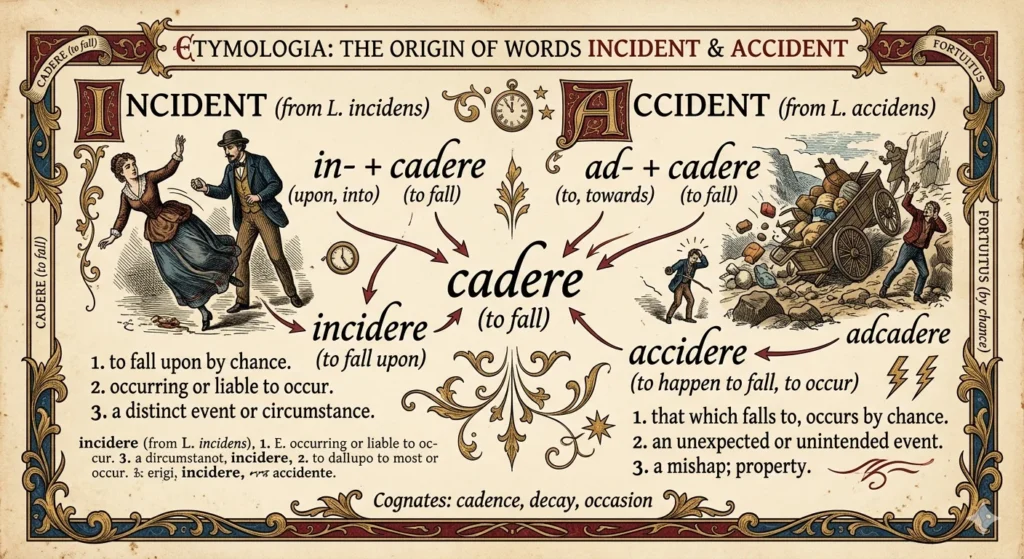
This word means “to happen or fall upon.”
Over time, the word started to describe any event that occurs, especially something unusual or unexpected.
Today it is used in many situations:
- security incident
- workplace incident
- aviation incident
Origin of “Accident”
The word accident comes from the Latin word “accidere.”
This means “to happen suddenly.”
In English, the word developed a meaning connected with harm or damage.
Examples include:
- car accident
- industrial accident
- flight accident
Because of this history, an accident usually implies that something harmful happened.
British English vs American English Usage
Unlike some words in English, incident and accident are spelled the same in both British and American English.
However, their usage in reports and systems may differ slightly.
Usage Comparison
| Context | Common Term |
|---|---|
| Police reports | Incident |
| Workplace safety | Incident or Accident |
| Traffic news | Accident |
| Aviation safety | Incident or Accident |
Aviation Usage
In aviation safety systems, the difference is strict.
| Term | Meaning |
|---|---|
| Aviation incident | A problem occurred but the aircraft remained safe |
| Aviation accident | Serious damage or injuries occurred |
Safety organizations use this classification to analyze risks and improve safety.
Which Word Should You Use?
Choosing the correct word depends on the situation.
Use “Incident” When
- No injury occurred
- No major damage happened
- The event is being investigated
Examples:
- workplace incident
- security incident
- aviation incident
Use “Accident” When
- Someone is injured
- Property damage occurs
- Insurance claims are involved
Examples:
- car accident
- workplace accident
- industrial accident
Simple Rule
Incident = event happened
Accident = event caused harm
Common Mistakes People Make
Many people use these words incorrectly.
Here are some common mistakes.
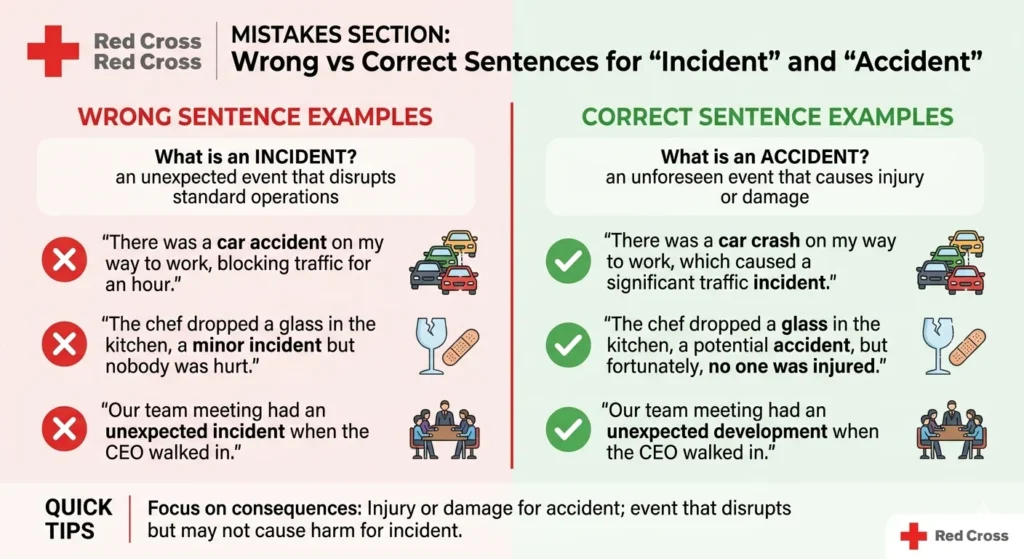
Mistake 1
Wrong:
“Small accident happened but nothing was damaged.”
Correct:
“Small incident happened but nothing was damaged.”
Mistake 2
Wrong:
“Worker injury incident.”
Correct:
“Worker accident.”
Mistake 3
Wrong:
“Near miss accident.”
Correct:
“Near miss incident.”
Mistake 4
Mixing report types.
| Report Type | Used For |
|---|---|
| Incident report | Event without injury |
| Accident report | Event with injury or damage |
Incident vs Accident in Everyday Examples
Workplace Example
Incident:
A worker trips but quickly stands up.
Accident:
A worker falls and breaks their arm.
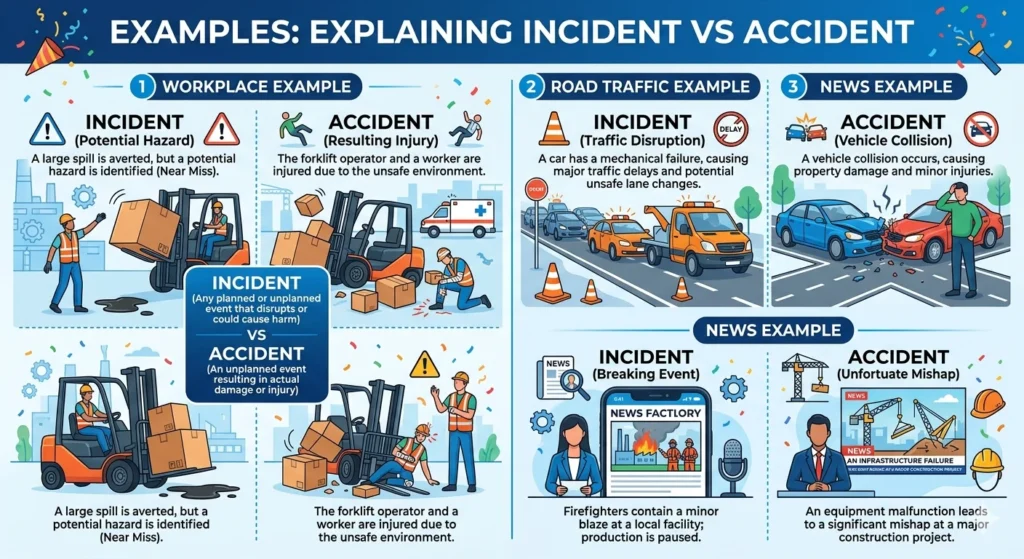
Road Traffic Example
Incident:
A driver suddenly brakes and avoids a crash.
Accident:
Two cars collide at an intersection.
Email Example
Incident message:
“There was a minor security incident in the office yesterday. No damage occurred.”
Accident message:
“A workplace accident occurred today in the warehouse. One employee was injured.”
News Example
News headlines often use the words carefully.
Example headlines:
- “Traffic accident blocks highway.”
- “Airport security incident under investigation.”
Usage Data and Popular Searches
Many people search online to understand these terms.
Popular search questions include:
- What is the difference between accident and incident?
- Is death an incident or accident?
- What are incident examples?
- What is the difference between incident and accident forms?
Countries where these searches are common include:
- United States
- United Kingdom
- Canada
- Australia
- India
These terms are widely used in safety, transportation, and workplace management.
Comparison Table: Incident, Accident, and Related Terms
| Term | Meaning | Example |
|---|---|---|
| Near miss | Almost happened but avoided | Tool almost hits worker |
| Incident | Event occurred without injury | Worker slips safely |
| Accident | Event caused injury or damage | Worker breaks leg |
| Injury | Physical harm | Broken arm |
Frequently Asked Questions
What is the difference between accident and incident?
An incident is an unexpected event.
An accident is an incident that causes injury, damage, or loss.
Is death an incident or accident?
If death happens because of an unexpected harmful event, it is usually classified as an accident.
What are incident examples?
Examples include:
- workplace slip without injury
- equipment malfunction
- small fire controlled quickly
- security system alert
What is the difference between incident and accident forms?
An incident form records events without injury.
An accident form records events that cause harm or damage.
Why do companies track incidents?
Companies record incidents to identify safety risks and prevent future accidents.
Can an incident become an accident?
Yes. An incident can lead to an accident if the situation becomes more serious.
Conclusion
The difference between incident and accident may seem small, but it is important in safety, communication, and reporting.
An incident refers to any unexpected event. It may or may not cause harm. These events often serve as warning signs that something might be wrong.
An accident, however, is more serious. It usually means that someone was injured or property was damaged. Because of this, accidents require investigation and documentation.
Understanding the difference helps organizations improve safety. When companies record incidents properly, they can identify risks and prevent accidents before they happen.
In everyday conversation, people sometimes use the two words interchangeably. But in professional settings such as workplaces, transportation systems, and aviation safety reports, the distinction is clear.
Remember the simple rule:
Incident = unexpected event
Accident = harmful event
Using the correct word makes communication clearer and helps create safer environments for everyone.

Mark Twain was an American author celebrated for his humor, sharp social commentary, and adventurous stories that captured the spirit and voice of everyday life.