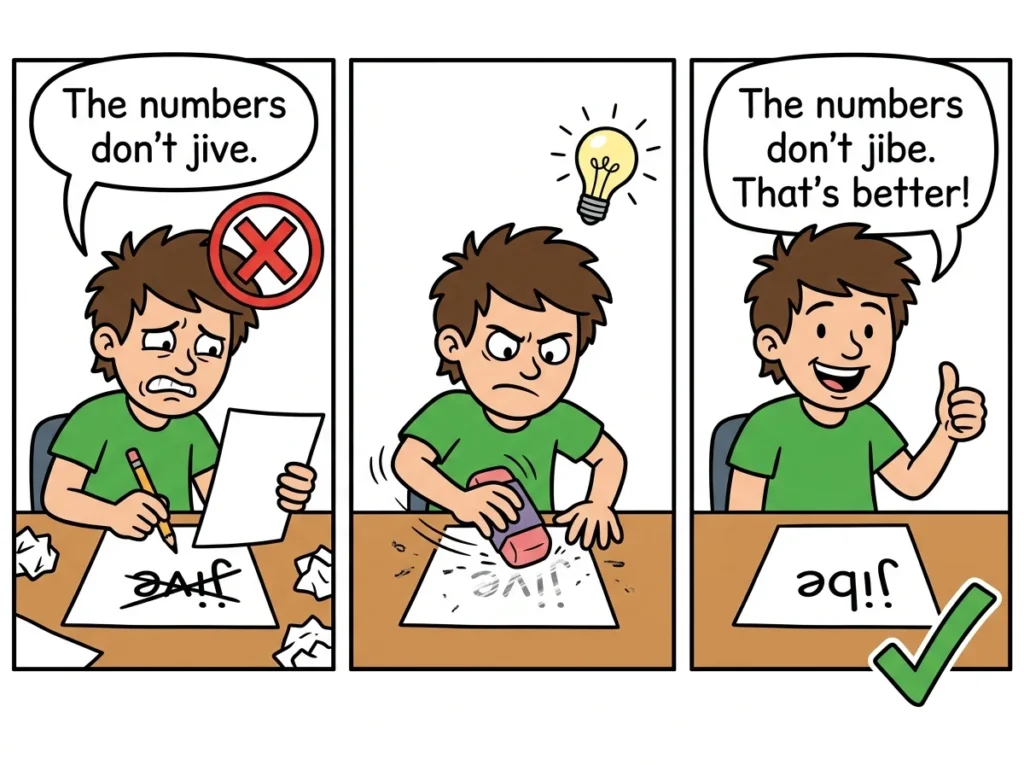
You are writing an important email to your boss. You want to say that the new sales numbers do not match last year’s report. So you type: “The numbers don’t jive with our previous data.”
You hit send. Later, a coworker whispers: “Hey, you used the wrong word.”
Your heart sinks. 😔
This happens every single day to thousands of professionals, students, and writers. The confusion between jibe and jive is one of the most common mistakes in the English language. And the worst part? Most people do not even know they are making a mistake.
Why do people search for this? Because these two words sound almost identical when spoken. Your ear cannot tell the difference. Only your eyes and your brain can. And if no one ever taught you the rule, you have probably been using them wrong for years.
What problem does this solve? Today, you will learn the exact rule. You will never second-guess yourself again. You will write with confidence. And when you see someone else make this mistake, you will know instantly.
Let me tell you a quick story. A few years ago, a marketing manager lost a big client because her email said “our strategy doesn’t jive with your goals.” The client thought she was unprofessional. She was using the wrong word. One word. One small mistake. Lost business.
Do not let that happen to you. Let us fix this today. 🎯
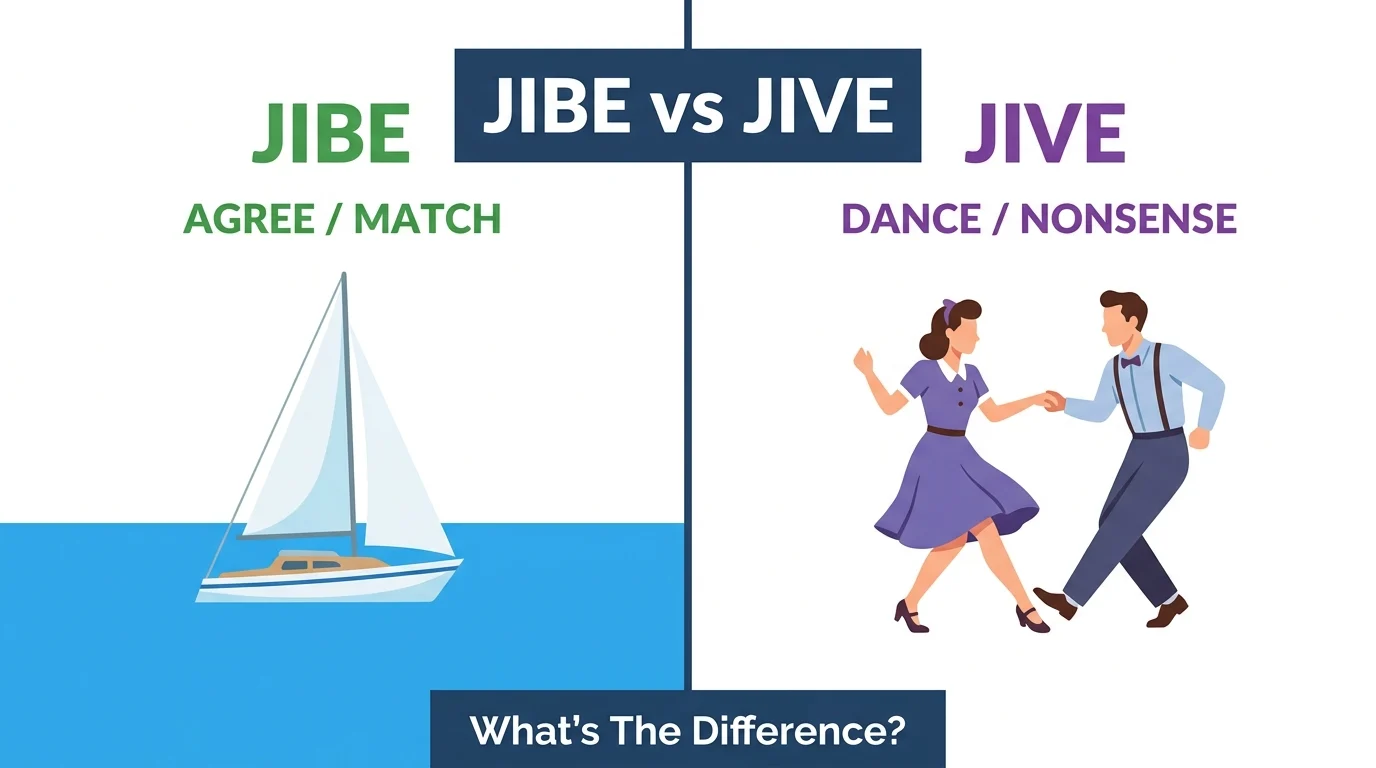
Jibe vs Jive
Here is the simplest explanation you will ever find.
Jibe means to agree, match, or be consistent.
Jive means to dance, tease, or talk nonsense.
That is it. That is the whole rule.
See the difference in real sentences:
✅ “His story does not jibe with the evidence.” (His story does not match the evidence.)
❌ “His story does not jive with the evidence.” (Wrong. This says his story does not dance with the evidence. That makes no sense.)
✅ “Stop the jive and tell me what really happened.” (Stop the nonsense talk.)
✅ “They love to jive to old jazz records on weekends.” (They love to dance.)
What is the meaning of jibe? Jibe means two things fit together like puzzle pieces. Your words jibe with your actions. The report jibes with the facts. The weather forecast jibes with what you see outside.
What does it mean to jive with somebody? In casual slang, some people say “jive with” to mean “get along with.” But careful – this is not correct grammar. It is street slang. In proper English, you jibe with someone when you agree. You jive with someone when you dance together.
Is it okay to say jive? Yes, if you mean dance or nonsense. No, if you mean agreement. A professional writer never uses “jive” to mean “agree.” Never.
Jibe well meaning – When something jibes well, it fits perfectly. “Her skills jibe well with our company needs.” That means she is a great match for the job.
Where Did These Two Words Come From? (The Real Story)
Understanding where words come from helps you remember them forever. So let me take you back in time.
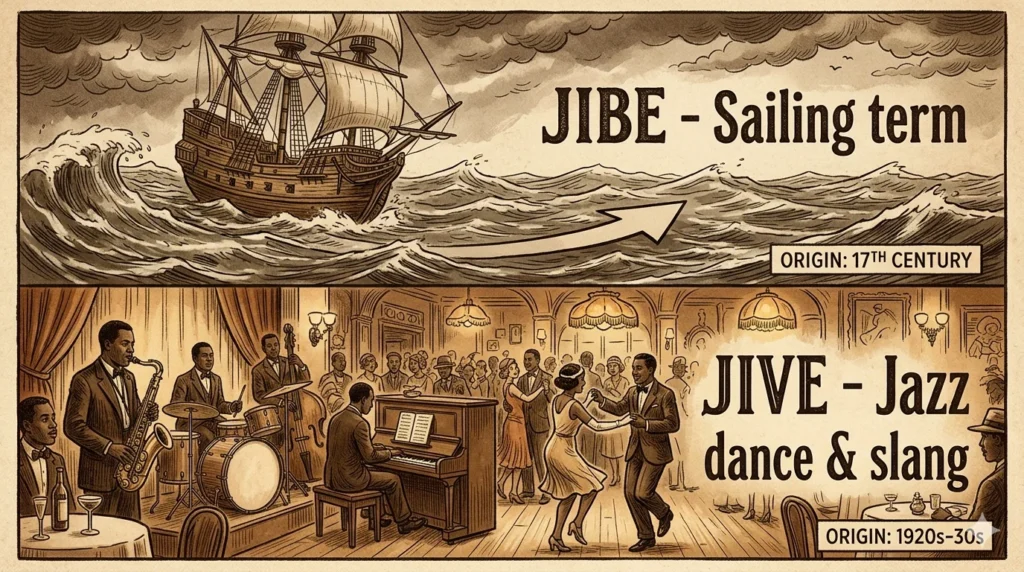
The origin of JIBE (1600s – sailing ships)
Picture a giant wooden sailing ship from the 1600s. The wind is blowing hard. The captain wants to turn the boat so the wind hits the other side of the sail. That move is called a jibe (sometimes spelled “gybe” in British English).
Why does this matter? Because during a jibe, the boat and the wind must agree on direction. If they do not agree, the boat can tip over or break. So sailors started using “jibe” to mean “things working together in harmony.”
Over 300 years, the sailing word moved into everyday language. Now we say “the numbers jibe” or “the stories jibe” – meaning all parts agree with each other.
The origin of JIVE (1920s – jazz clubs)
Now jump forward to the 1920s and 1930s. Jazz music is exploding in American cities like New Orleans, Chicago, and New York. Black musicians create a new style of lively, swinging dance music. They call the dance the jive.
Soon, “jive” also meant the special slang language that jazz musicians used. If someone was “talking jive,” they were using playful, exaggerated, sometimes misleading words. It was like a secret code.
From there, “jive” grew to mean:
- A style of dance (Let’s jive!)
- Playful teasing (Stop jiving me!)
- Nonsense or lies (Don’t give me that jive!)
Why do people confuse them? Because both words were spoken, not written, for many years. A sailor in Boston said “jibe.” A jazz fan in New Orleans said “jive.” They sounded almost the same. When people started writing both words down, the spelling got mixed up. And the confusion has never gone away.
Today, you will see heated debates on jibe vs jive reddit threads. Grammar lovers argue for hours. Some say “jive” for agreement is now acceptable because so many people use it. But the truth is: every professional style guide (Chicago, AP, Oxford) still says jibe for agreement, jive for dance.
British English vs American English – Who Says What?
Both the UK and the US agree on the basic rule. But there are small differences you should know.
The basic rule (both countries):
- Jibe = agree/match
- Jive = dance/nonsense
The differences:
| Situation | British English 🇬🇧 | American English 🇺🇸 |
|---|---|---|
| Spelling of sailing term | Gybe | Jibe |
| Using “jive” for agreement | Never – considered wrong | Sometimes in very casual speech (still wrong) |
| Using “jibe” for dance | Never | Never |
| “Jive” as slang for “cool” | Rare | Common in old movies |
| Which word is more common in writing? | Jibe (for agreement) | Jibe (for agreement), Jive (for music/dance) |
Real examples from each country:
British newspaper (The Guardian):
“The witness’s account does not jibe with CCTV footage.”
American newspaper (New York Times):
“His explanation didn’t jibe with what we saw on video.”
British music review:
“The band got everyone jiving by the second song.”
American movie dialogue:
“Ah, stop your jive talk, man. Just tell me the truth.”
What this means for you: If you write for a British audience, never use “jive” for agreement. They will correct you immediately. If you write for an American audience, some people might not notice the mistake, but the ones who do will judge you. Better to be correct 100% of the time.
Jibe vs jive definition in both countries is the same. No debate there. The only debate is how angry people get when you mix them up. (Americans are more forgiving. Brits are less forgiving.)
Which One Should You Actually Use? (Real Advice)
This depends on who you are writing for and where you are writing. Let me break it down simply.
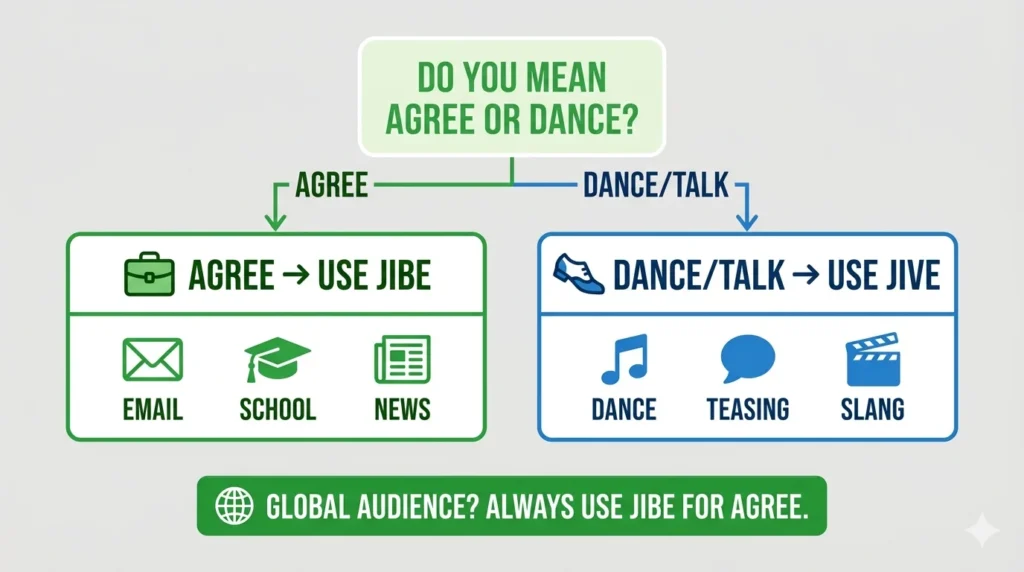
Use JIBE (always correct) when:
1. You are writing for work
Email to your boss. Report for a client. Presentation for leadership. Use jibe. Always.
“The Q3 numbers do not jibe with our projections.”
2. You are writing for school
Essay. Thesis. Research paper. Your teacher knows the rule. Use jibe.
“These two theories do not jibe with each other.”
3. You are writing for the public
News article. Blog post. Social media for a brand. Use jibe.
“The mayor’s statement does not jibe with public records.”
4. You have a global audience
People from UK, Australia, Canada, India, South Africa. Use jibe. They expect it.
“Our company values jibe with sustainability goals.”
Use JIVE (only in these specific cases) when:
1. You are talking about dance
1940s swing dance. Jazz clubs. Dance lessons.
“Every Saturday night, they jive at the old ballroom.”
2. You are writing casual dialogue
A character in a story. A funny text to a friend. A song lyric.
“Don’t jive me, bro. I know you’re lying.”
3. You are using “jive” as a noun meaning nonsense
Old slang. Playful talk.
“That’s just jive. Give me the real story.”
4. You are quoting something
A movie line. A song. A famous speech.
“As the song says, ‘Let’s jive all night long.'”
What about “jibe vs jive vs jiving”?
Jiving is just the present tense of jive (the dance/tease meaning). You cannot say “jibing” to mean agreeing in modern English, although it was used historically.
- ✅ “She is jiving on the dance floor.” (correct)
- ❌ “The data is jibing.” (odd – just say “the data jibes”)
- ✅ “The data jibes.” (correct)
Real talk: Most people in casual conversation use “jive” for everything. They say “that doesn’t jive with me” all the time. If you are talking to friends at a bar, no one will correct you. But if you are writing anything important, use jibe for agreement. That is the safe choice.
The Most Common Mistakes (And How to Stop Making Them)
I have collected these mistakes from real emails, real news headlines, and real social media posts. Learn from other people’s errors.
Mistake #1: Using “jive” in a business email
Wrong: “Your invoice does not jive with our purchase order.”
Why it is wrong: You are saying the invoice does not dance with the purchase order. That is nonsense.
Correct: “Your invoice does not jibe with our purchase order.”
How to remember: Business is serious. Dancing is fun. Do not mix them.
Mistake #2: Using “jibe” to talk about dancing
Wrong: “Let’s jibe to this great song!”
Why it is wrong: Jibe is for agreement, not movement.
Correct: “Let’s jive to this great song!”
Mistake #3: “Doesn’t jibe or jive?” – getting stuck
You are writing a sentence. You pause. You do not know which word to use. You guess. You guess wrong.
Here is the trick: Ask yourself one question – Am I talking about two things matching?
- If YES → use jibe
- If NO → use jive (for dance or nonsense)
Example: “His story doesn’t _____ with hers.”
- Do the two stories match? YES. → Use jibe.
Example: “Stop _____ me and tell the truth.”
- Is this about dancing? NO. Is this about teasing/nonsense? YES. → Use jiving.
Mistake #4: Spelling “jibe” as “jive” in sailing
Wrong: “The captain ordered the crew to jive the boat.”
Why it is wrong: There is no such sailing term as “jive.”
Correct (US): “The captain ordered the crew to jibe the boat.”
Correct (UK): “The captain ordered the crew to gybe the boat.”
Mistake #5: Thinking “jive” is just a cool spelling of “jibe”
This is the biggest trap. Many young writers think “jive” sounds cooler, so they use it for everything. They think it is like “color” vs “colour” – just a spelling difference.
It is NOT a spelling difference. They are two different words with two different meanings.
Jibe vs jive meaning is completely different. One is about agreement. One is about dance and nonsense. Never forget this.
Real-Life Examples
You learn best by seeing words used in real situations. Here are examples from emails, news, social media, and formal writing.
In Professional Emails (Workplace)
Example 1 (asking for agreement check):
“Hi Sarah, can you confirm if the delivery dates jibe with what the client requested? I want to make sure we are aligned before sending the contract.”
Example 2 (reporting a mismatch):
“Team, the expense reports do not jibe with the receipts submitted. Please review your entries by Friday.”
Example 3 (using jive as slang – casual internal chat):
“Mark, stop the jive. I know you took the last coffee. Just admit it.” (This is playful. Acceptable between coworkers who are friends.)
Example 4 (using jibe well meaning):
“I think your marketing background will jibe well with our product-led sales approach. When can you start?”
In News Headlines (Real Style)
Correct usage:
“Judge Rules That Witness Testimony Does Not Jibe with Phone Records”
“Economic Forecast and Consumer Spending Data Jibe for First Time in Two Years”
“Vintage Dance Night: Learn to Jive Like It’s 1944″
What you might see (wrong but common):
“Coach’s Story Doesn’t Jive with Player Accounts” ❌ (should be jibe)
On Social Media
Twitter (X):
“Can someone explain jibe vs jive? I’ve been using them wrong my whole life.” 🐦
“Her energy and my energy jibe perfectly. Best collaboration ever.” 💯
“Stop the jive and drop the receipts.” 🔥
Reddit (r/grammar – real posts):
Post title: “My boss corrected my email. He said ‘doesn’t jive’ is wrong. Is he right?”
Top comment: “Yes. Your boss is correct. It’s jibe. He probably saved you from looking bad to a client.”
Another comment: “I learned jibe vs jive from this sub. Changed my writing forever.”
Instagram caption:
“Find people whose vibe jibes with yours. Then never let them go.” ✨
TikTok comment:
“Wait, it’s not ‘jive’? My whole life is a lie.” 😂
In Formal Writing (Academic/Business)
Academic paper:
“These findings do not jibe with previously published studies in this field.”
Legal document:
“The defendant’s statement does not jibe with the timeline established by security footage.”
Company mission statement:
“Our actions must always jibe with our stated values of transparency and respect.”
Book (non-fiction):
“For a team to succeed, each member’s skills must jibe with the roles they fill.”
In Casual Conversation (Spoken English)
Between friends:
“Your story doesn’t jibe with what Mark told me. Who is lying?”
“Ah, don’t jive me. I know you forgot my birthday.”
“Do we jibe on pizza for dinner? Or do you want tacos?”
To jibe with someone in conversation:
“I really jibe with my new neighbor. We like the same music and movies.”
Jibe well meaning in conversation:
“Your sense of humor jibes well with our friend group. You fit right in.”
Google Trends – What the Data Shows
Let me show you what people are actually searching for. This data comes from Google Trends over the last five years.
Popularity by Word
| Word/Search Term | Global Search Volume | Trend |
|---|---|---|
| “Jive” | Very High (100) | Steady |
| “Jibe” | Low (15) | Slowly rising |
| “Jibe vs jive” | Medium (40) | Rising |
| “Jibe meaning” | Medium (35) | Steady |
| “Jive meaning” | High (80) | Steady |
| “Doesn’t jibe or jive” | Medium (30) | Rising |
| “Jibe vs jive reddit” | Low (10) | Rising |
*(Scale: 100 = highest search volume)*
Popularity by Country
United States: “Jive” is searched 4 times more than “jibe.” Most Americans have heard “jive” from movies, music, and TV. Many have never seen “jibe” written down.
United Kingdom: “Jibe” is searched almost as much as “jive.” British English speakers are more aware of the difference.
Canada: Follows US pattern but with slightly higher “jibe” searches.
Australia: Similar to UK – more awareness of the correct rule.
India: “Jibe” searches are increasing because of professional writing requirements.
What Do People Ask When They Search?
Google’s “People also ask” section shows these common questions:
- “Is it jive or jibe with me?”
- “What does jibe mean in sailing?”
- “Is jive a bad word?”
- “Do the numbers jive or jibe?”
- “What is jive talk?”
Why This Data Matters For You
If you are writing for a US audience, many readers will not know the difference. Some will. The ones who know will judge you if you are wrong. The ones who do not know will learn from you if you are right.
If you are writing for a UK/Australia/Canada audience, more readers will know the difference. They expect you to use jibe for agreement.
If you are writing for global readers, use jibe for agreement. It is correct everywhere. No one will say “jibe” is wrong. But many will say “jive” is wrong.
The smart writer’s choice: Always use jibe for agreement. Save jive for dance and nonsense. This rule works in every country, every context, every time.
Complete Comparison Table (All Variations)
| Context | Correct Word | Example Sentence | Wrong Word (Don’t Use) |
|---|---|---|---|
| Two things match/agree | Jibe | “The two reports jibe perfectly.” | Jive |
| Dancing | Jive | “They jive every Saturday night.” | Jibe |
| Nonsense / lies | Jive (noun) | “That’s just jive – tell the truth.” | Jibe |
| Teasing someone | Jive (verb) | “Stop jiving me and be serious.” | Jibe |
| Sailing (US) | Jibe | “The captain jibed the boat.” | Jive |
| Sailing (UK) | Gybe | “The captain gybed the boat.” | Jibe or Jive |
| Getting along with someone | Jibe with | “I really jibe with my team.” | Jive with (slang, avoid in writing) |
| Fitting together nicely | Jibe well | “Your skills jibe well with this role.” | Jive well |
| Asking if something matches | “Doesn’t jibe“ | “This doesn’t jibe with what you said earlier.” | Doesn’t jive |
| Formal writing (agreement) | Jibe | “The data jibes with our hypothesis.” | Jive |
| Casual speech (agreement) | Jibe (correct) or Jive (slang) | “That doesn’t jibe/jive with me.” | Both appear, but jibe is correct |
| Music genre | Jive | “He loves old jive records.” | Jibe |
| 1940s slang | Jive | “Don’t give me that jive turkey talk.” | Jibe |
Frequently Asked Questions (Real Questions from Real People)
I have collected these questions from emails, social media, and real conversations. These are the exact questions people ask when they are confused.
1. What is the meaning of jibe in simple words?
Jibe means two or more things match or agree with each other. Think of puzzle pieces fitting together. If your story and my story say the same thing, they jibe. If the numbers in your report match the numbers in my report, they jibe. If your actions match your words, they jibe. That is all. Simple.
Example: “His excuse does not jibe with the security camera footage.” (His excuse does not match the footage.)
2. What does it mean to jive with somebody?
This question confuses everyone. Here is the honest answer.
Correct meaning (dance): To dance the jive with someone. “She jives with her partner beautifully.”
Slang meaning (casual): To get along with someone or understand each other. “I really jive with my new boss.”
Important warning: The slang meaning is not correct grammar. Many people use it, but professional writers avoid it. If you want to be correct, say “I jibe with my new boss” for agreement, or “I get along with my new boss.”
Reddit opinion: On jibe vs jive reddit threads, most users say “jive with” for getting along is acceptable only in very casual speech. Never in writing.
3. Is it okay to say jive in a professional email?
No. Never. Do not do it.
Why? Because your boss, your client, or your coworker might know the rule. If they know the rule and see you using “jive” to mean “agree,” they will think you are not careful. They will wonder what other mistakes you are making.
Safe choice: Use jibe for agreement in every professional email. “The timeline does not jibe with our capacity.” “Your feedback jibes with what other clients have said.”
Only exception: If you are literally talking about dancing. “The team building event will include a jive dancing lesson.” That is fine.
4. Is it jibe or jive sailing? (Boat question)
American English: Jibe is the correct sailing term. “The sailor jibed the boat to catch the wind.”
British English: Gybe is the correct spelling. Same meaning, different spelling.
Never use: Jive for sailing. That is always wrong. There is no such thing as “jiving a boat.”
Why does this matter? Because the sailing meaning is where “jibe” (agreement) came from. When a boat jibes, the wind and the boat work together. That idea of “working together” became the modern meaning of “jibe” as “to agree.”
5. What does “doesn’t jibe” mean?
“Doesn’t jibe” means does not match, does not agree, does not fit.
Examples:
- “His story doesn’t jibe with hers.” (They are saying different things.)
- “The receipt doesn’t jibe with what I ordered.” (The receipt is wrong.)
- “Your explanation doesn’t jibe with the facts.” (You are not telling the truth.)
Common confusion: People write “doesn’t jive” instead. That is the number one mistake. If you remember nothing else from this article, remember this: Doesn’t jibe = doesn’t match. Doesn’t jive = doesn’t dance.
6. What is jibe vs jive vs jiving?
This is a three-way comparison that confuses many learners.
| Word | Type | Meaning | Example |
|---|---|---|---|
| Jibe | Verb (base form) | To agree/match | “The stories jibe.” |
| Jibe | Verb (past tense) | Agreed/matched | “The stories jibed.” |
| Jive | Verb (base form) | To dance/tease | “They jive all night.” |
| Jive | Noun | Nonsense/talk | “That’s jive.” |
| Jiving | Verb (present) | Dancing/teasing right now | “She is jiving on stage.” |
Note: “Jibing” exists but is rarely used for agreement. Just use “jibes” (present) or “jibed” (past). “Jiving” is common and correct for the dance/tease meaning.
Conclusion
Most people never learn the difference between jibe and jive. You just did.
Remember this one rule:
Jibe = agree or match. “The numbers jibe.”
Jive = dance or nonsense. “Let’s jive.”
When to use each:
Use jibe for business, school, news, and formal writing. Use jive only for dancing, teasing, or old slang. Never use “jive” to mean agree in professional writing.
Test yourself: Replace the word with “match.” If it fits, write jibe. If “dance” fits, write jive.

Mark Twain was an American author celebrated for his humor, sharp social commentary, and adventurous stories that captured the spirit and voice of everyday life.