Have you ever paused while typing an email, wondering if you should write “I have ran” or “I have run”? 🤔 You are not alone. This is one of the most confusing grammar traps in the English language.
People search for “ran vs run” because they get confused by the vowel change. Is it “will be run” or “will be ran”? Should I use “ran a test” or “run a test”?
The good news is that the rule is very simple. Run is for the present and future. Ran is strictly for the past.
But wait—there is another common confusion! People often mix up the words “waiving” and “waving.” Are you waiving a fee or waving a fee? We will clear this up too.
By the end of this guide, you will never make a mistake with these words again. Let’s dive into the ultimate grammar fix! 🚀
Ran vs Run? ⚡
Here is the fastest way to remember it:
- Run = Present or Future (happening now or later).
- Ran = Simple Past (happened before now).
Simple Examples:
- I run every morning at 6 AM. (Present)
- I ran 5 miles yesterday. (Past)
- I will run a marathon next year. (Future)
Crucial Rule: After the words have, has, or had, you must use RUN (because it is the past participle).
- ✅ Correct: I have run.
- ❌ Wrong: I have ran.
What is the Difference Between Ran and Run? (Origin) 📜
The difference lies in time and grammatical tense.

- Run is the base form (Infinitive).
- Ran is the Simple Past tense.
Why do they sound different?
The words come from Old English “rinnan.” Over centuries, English speakers changed the vowel sound to show that time had passed. This is called Ablaut (vowel change).
The Three Key Forms of “Run”:
- Base Form (Present): Run
- Simple Past: Ran
- Past Participle: Run (This is the one people forget!)
Pronunciation Tip (Run pronunciation):
- Run rhymes with Sun (Sound: /rʌn/).
- Ran rhymes with Man (Sound: /ræn/).
Focus on the vowel sound to hear the time difference!
When to Use Ran vs Run? (Grammar Rules) 📝
This is the most important section. Follow these 3 ironclad rules to know when to use ran vs run.
1. Use “RUN” for the Future Tense 🚀
Whenever you use will, shall, going to, or can, you must use the base form (run).
- I will run the software update tonight.
- She is going to run for president.
- Can you run to the store for me?
2. Use “RAN” for the Simple Past 🔙
If the action is finished and you mention a specific past time (yesterday, last week, in 2020), use ran.
- We ran out of milk this morning.
- He ran the meeting efficiently last Tuesday.
3. The “HAVE” Rule (Past Participle) ⚠️
If you see the words have, has, or had, you must use RUN. The past participle of run is run, not ran.
- ✅ I have run this company for 10 years.
- ✅ The test has run successfully.
- ❌ I have ran this company. (Big No!)
Common Query Answer: When asking “Is it run or ran a test?” the answer depends on time. If you did it yesterday: “I ran a test.” If you are doing it now or soon: “I will run a test.” If you are talking about an experience: “I have run a test.”
What are Common Grammar Mistakes with Ran and Run? 🛑
Let’s look at the most frequent errors that ruin professional writing.
| Wrong Usage ❌ | Correct Usage ✅ | Explanation |
|---|---|---|
| I have ran away. | I have run away. | After “have,” use the past participle “run.” |
| The race was ran well. | The race was run well. | Passive voice needs the past participle “run.” |
| I will ran tomorrow. | I will run tomorrow. | After “will,” always use the base form. |
| The system ran smoothly now. | The system runs smoothly now. | “Now” is present, so use “runs.” |
The Million-Dollar Question: Will be run or will be ran?
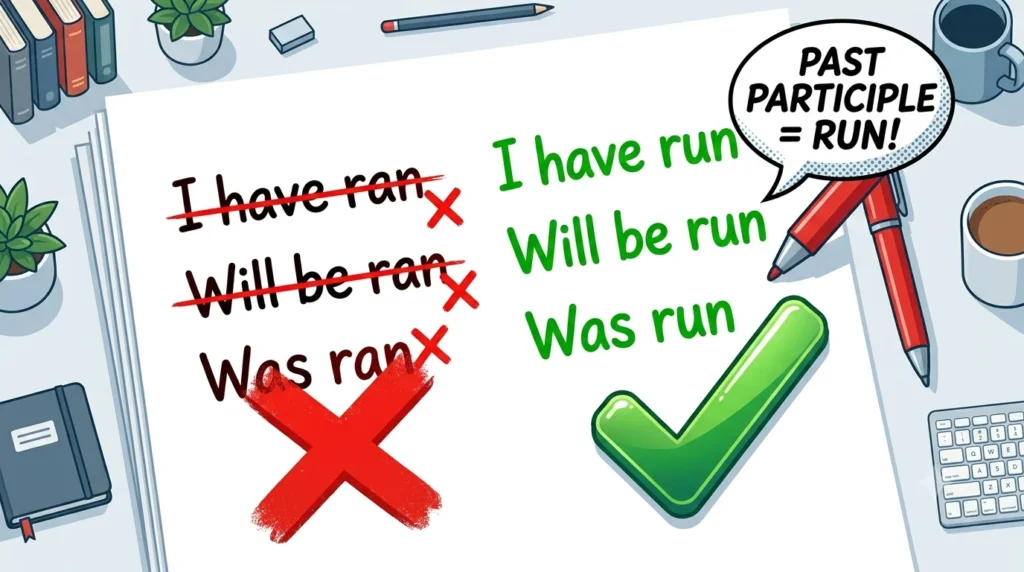
The correct phrase is “will be run.”
Why? Because this is passive voice. In passive voice, you always use the Past Participle. As we know, the past participle of “run” is “run.”
- ✅ The marathon will be run by thousands.
- ❌ The marathon will be ran by thousands.
Waiving vs Waving – What’s the Difference? 🙋♂️
A lot of people confuse “ran/run” with “waiving” and “waving” because they also have different meanings and spellings. Let’s solve this confusion right now.
Is it waiving a fee or waving a fee?
The correct answer is waiving a fee.
- Waiving (Verb): Means to give up a right, rule, or claim. It means to not enforce something.
- Example: The bank is waiving the late payment fee this month. (They are removing the charge).
- Waving (Verb): Means to move your hand back and forth, or to signal.
- Example: She was waving her hand to greet me.
Memory Trick:
- Waive has an I in it. Think: “I give up the fee.”
- Wave has an E in it. Think: “Everyone moves their hand.”
Ran vs Run in Everyday Examples 💬
Let’s see how these words look in real life—from emails to news headlines.
In Professional Emails 📧
- Subject: Testing Phase – “We ran the diagnostics last night, but we need to run them again today. The system has run into a minor glitch.”
In News Headlines 📰
- Present: “Oil Prices Run High as Demand Grows.”
- Past: “President Ran a Strong Campaign in 2024.”
- Future: “The New Train Service will be Run by a Private Company.”
On Social Media 📱
- “Just ran my fastest mile! 🏃♂️💨”
- “I run on coffee and chaos. ☕😅”
- “My phone battery has run out. SOS!”
In Formal / Academic Writing 📚
- “The experiment ran for six weeks.”
- “The trial will be run under strict laboratory conditions.”
- “Researchers have run multiple statistical models to verify the data.”
What Does Google Trends Data Say About Ran vs Run? 📊
According to global search data:

- Regional Popularity: The word “run” is searched 5 times more than “ran” globally. It ranks highest in the US, UK, and Australia.
- Seasonal Trends: Searches for “run” peak in January (New Year resolutions) and during spring (marathon season).
- Context: Users searching “ran” usually look for past tense verification (e.g., “ran into meaning”). Users searching “run” often look for software or business execution (e.g., “run a program”).
- “Will be run”: This is searched primarily by project managers and corporate professionals checking grammar for meeting reports.
Comparison Table: Ran vs Run Side by Side 📋
| Feature | Run | Ran |
|---|---|---|
| Tense | Present / Future / Past Participle | Simple Past |
| Used With | I, You, We, They, Will, Can, Have | I, You, He, She, We, They (finished actions) |
| Pronunciation | Rhymes with Sun (rʌn) | Rhymes with Man (ræn) |
| Example (Now) | I run every day. | – |
| Example (Yesterday) | – | I ran yesterday. |
| Example (Have) | I have run the race. | ❌ I have ran the race. |
| Example (Passive) | The show will be run well. | ❌ The show will be ran well. |
FAQs about Ran vs Run and Waiving vs Waving ❓
1. Should I use run or ran?
Use run for present/future and after “have.” Use ran for past actions. Example: “I run today” vs “I ran yesterday.”
2. What is the difference between run and ran?
“Run” is the base and past participle form. “Ran” is only the simple past tense.
3. Is it “has run” or “has ran”?
It is “has run”. “Has” requires the past participle. The past participle of “run” is “run.”
4. Is it “will be run” or “will be ran”?
It is “will be run”. Passive voice uses the past participle, which is “run.”
5. What is the past tense of “run”?
The simple past tense is “ran.” (e.g., “I ran to school.”)
6. What is the past participle of “run”?
The past participle is “run.” (e.g., “I have run a marathon.”)
7. Is it “waiving a fee” or “waving a fee”?
It is “waiving a fee”. “Waive” means to give up a charge. “Wave” means to move your hand.
8. How do you pronounce “run” and “ran”?
Run rhymes with “Sun” (ruhn). Ran rhymes with “Man” (rahn). The vowel sound changes completely.
Conclusion 🏁
Mastering the difference between ran vs run is easy when you remember the timeline.
To summarize:
- Ran is only for the past. If it happened before now, use ran.
- Run is for everything else: the present, the future, and anytime you use the words have, has, or had. Remember, you will be run the program, not will be ran.
- And do not forget waiving vs waving: You waive a fee and wave your hand.
Using these words correctly makes your writing look professional and smart. The next time you are typing an email or posting on social media, just ask yourself: “Did this happen already?” If yes, go with RAN. If not, go with RUN.
Keep practicing, and soon this grammar rule will become second nature! Happy writing! ✍️🔥

E.M. Forster was an English novelist celebrated for his insightful stories about class, connection, and humanity, blending gentle humor with deep social themes.