Have you ever paused mid-sentence, frozen by the fear of choosing the wrong word? You are not alone. The battle between reoccurrence and recurrence confuses thousands of writers, students, and professionals every single day.
People search for this keyword because they see both spellings used in official reports, medical documents, and casual emails—and they desperately want to know which one is correct. The truth is, both are correct, but they carry different weights and meanings.
Using the wrong one can make your writing sound amateur or, worse, change the meaning of your sentence entirely. This guide is designed to kill that confusion permanently. By the end of this short read, you will never have to guess again. Let us settle this debate once and for all. 🎯
Reoccurrence vs Recurrence
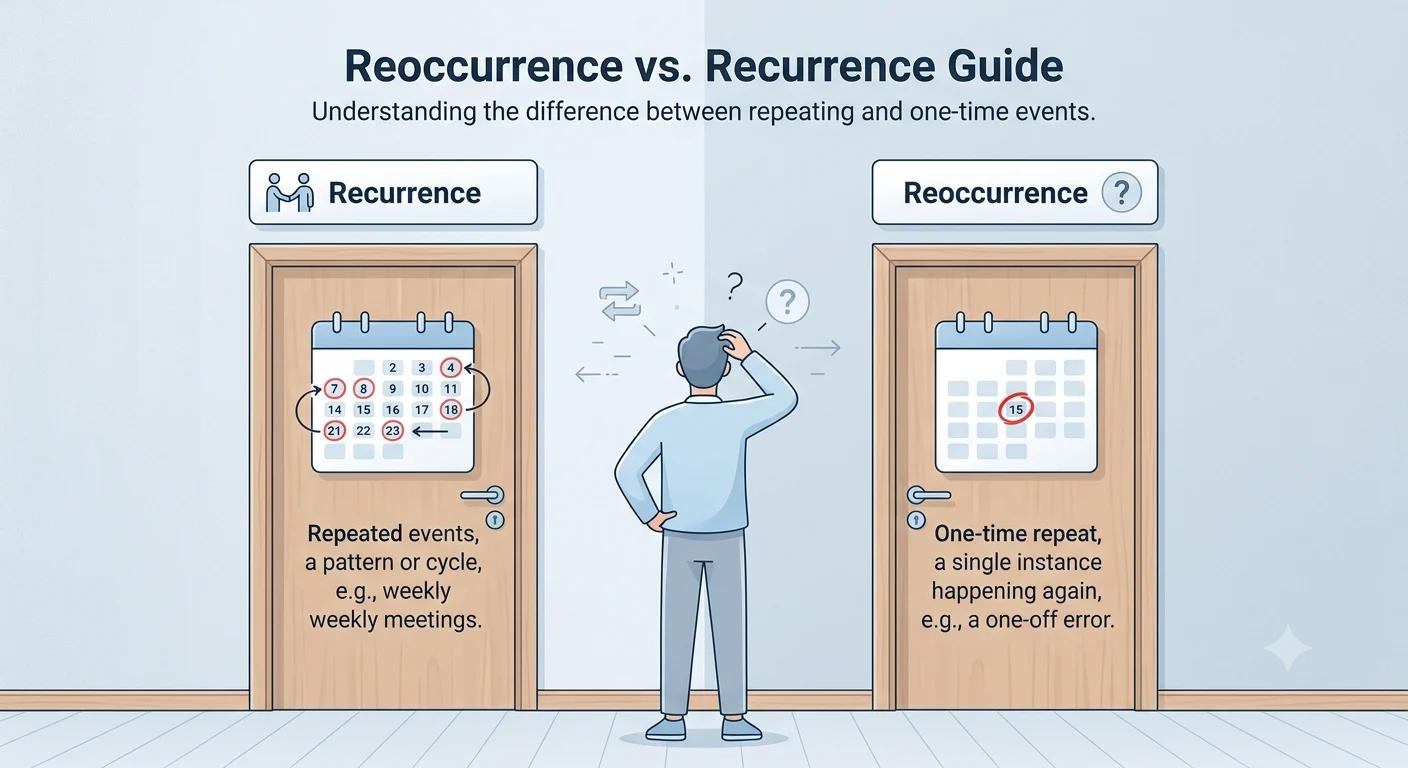
Here is the fastest way to remember the difference. Recurrence means something happens again and again, often in a predictable pattern. Reoccurrence means something happens one more time, but without the promise of a third or fourth round.
Think of a morning sunrise—that is a recurrence because it happens every single day. Now, imagine you spill your coffee on a Monday, and then you spill it again on a Tuesday. That second spill is a reoccurrence. It happened again, but hopefully, it will not become a daily habit. If you are ever in doubt about the reoccurrence vs recurrence meaning, just ask yourself: Is this a pattern, or is it just a one-time repeat?
The Origin of Reoccurrence vs Recurrence
Understanding the history helps solidify the rule. The word “recur” entered the English language in the early 1500s. It originates from the Latin word recurrere, which literally translates to “to run back.” During the Middle Ages, it was often used in a religious context, meaning to turn back to God for help. By the 1600s, it evolved to mean “to happen again,” specifically in a frequent or periodic manner.

The word “reoccur” is actually a much younger sibling. According to historical language records, it did not appear until 1734. It was formed simply by adding the prefix “re-” to the word “occur.” Because “occur” means to happen, “reoccur” simply means to happen again—without the baggage of frequency. This is why reoccurrence vs recurrence vs reoccur is so confusing; “reoccur” is the verb, and “reoccurrence” is the noun derived from it.
British English vs American English Spelling
Here is a surprise for you: this is not a US vs UK argument. Unlike “color” and “colour,” both nations spell these words identically. The difference is entirely based on logic and meaning, not geography. However, the frequency of use does differ slightly.
| Feature | Recurrence (The Champion) | Reoccurrence (The Underdog) |
|---|---|---|
| Core Meaning | Happens repeatedly or in cycles | Happens again (usually once) |
| Usage Frequency | Very common (25x more popular) | Rarely used in print |
| Formal Writing | Highly preferred | Often avoided |
| Medical Context | The standard term (e.g., Cancer) | Used loosely but rarely |
| Dictionary Status | Primary entry in all dictionaries | Listed as a secondary variant |
| Spelling (UK/US) | Same spelling globally | Same spelling globally |
If you are looking up how do you spell reoccurrence in the UK, the answer is exactly the same as in the US: R-E-O-C-C-U-R-R-E-N-C-E.
Which Spelling Should You Use?
Your audience determines your choice.
- For US Readers: Stick strictly to recurrence. It sounds more authoritative and polished. “Reoccurrence” might make you look like you made a spelling mistake.
- For UK/Commonwealth Readers: Again, choose recurrence. British English speakers value precision, and “recurrence” is the traditional, respected choice in publications like The Guardian or BBC.

- For Medical and Scientific Writing: This is critical. When discussing recurrence or reoccurrence cancer, the medical community universally prefers recurrence. The National Cancer Institute defines cancer returning as a “recurrence.” Relapse is slightly different, but we will cover recurrence vs relapse shortly.
- For Casual Conversation: Here is the nuance most guides miss. In everyday, informal chatting or social media, native speakers use them interchangeably. No one will correct you if you say “reoccurrence” in a text message.
Common Mistakes with Reoccurrence vs Recurrence
Avoid these landmines to keep your writing clean.
- ❌ Treating them as exact synonyms (The biggest mistake). As explained, they are not.
- ❌ Misspelling “Reoccurrence”. People often write reoccurence (missing the second “r”) or reocurrence (missing the second “o”). Break it down: Re + Occur + Rence.
- ❌ Using “Reoccurrence” in business reports. It looks informal. Always default to “recurrence” in official company memos or financial documents.
- ❌ Confusing “Recurrence” with “Relapse”. In healthcare, a relapse is the return of symptoms after a period of improvement. A recurrence is the return of the actual disease itself. All relapses are recurrences, but not all recurrences are relapses.
Reoccurrence vs Recurrence in Everyday Examples
Seeing these words in action makes the concept stick instantly.
- In Emails: “We need to discuss the recurrence of our Monday morning server slowdowns.” vs. “We have backup generators to prevent a reoccurrence of last week’s power cut.”
- In News Headlines: “Experts warn of a recurrence of seasonal flooding.” vs. “Community leaders vow to prevent a reoccurrence of the recent riots.”
- On Social Media: “I am exhausted by the recurrence of these toxic arguments in my feed.” vs. “I hope we do not see a reoccurrence of that horrible fashion trend.”
- In Formal Writing: “The study focused on the recurrence of symptoms in chronic patients.” vs. “New safety protocols were introduced to avoid the reoccurrence of the machinery error.”
Reoccurrence vs Recurrence – Google Trends & Usage Data
Let the data do the talking. According to search engine behavior, recurrence is searched for roughly 25 times more frequently than “reoccurrence.” In American literature, the ratio is even more lopsided—for every 79 uses of “recurrence,” there is barely 1 use of “reoccurrence.”

This massive gap exists because “recurrence” is the default term in dictionaries. When people search for reoccurrence vs recurrence synonym, they are usually just checking if “reoccurrence” is a valid word (it is) or if they should delete it. The data confirms that professionals, academics, and search engines all favor the shorter, sharper “recurrence.”
FAQs
1. What is the definition of reoccurrence?
The definition of reoccurrence is simply “the act of happening one more time.” It does not imply a cycle, a schedule, or a repeated pattern—just a singular repeat of a specific event.
2. Is it waiving a fee or waving a fee?
Since this is a common search query, here is the answer: Waiving means to refrain from enforcing a rule (like a fee). Waving means moving your hand back and forth. So, the bank is waiving your late fee, not waving it.
3. What is the difference between recurrence and recursion?
This is a trickier comparison. Recurrence is about events repeating over time. Recursion is a programming and mathematical term where a function calls itself within its own definition. They are completely unrelated concepts.
4. What is the meaning of the word recurrence?
The meaning of the word recurrence is “the state of occurring again, especially at regular intervals.” It implies frequency, pattern, and predictability.
5. How do you spell reoccurrence in the UK?
You spell it R-E-O-C-C-U-R-R-E-N-C-E. There is absolutely no difference between UK spelling and US spelling for this specific word.
6. Recurrence or reoccurrence cancer – which is correct?
Recurrence is the gold standard in oncology. Medical journals and doctors exclusively use “cancer recurrence” to describe the return of the disease after a period of remission.
7. Recurrence vs relapse – are they the same?
No. A relapse is the return of symptoms, whereas recurrence is the return of the actual disease. In mental health, you relapse into depression; in cancer, the tumor has a recurrence.
8. Can I use them interchangeably in casual writing?
Yes. While the technical distinction exists, native English speakers often use these as synonyms in everyday, informal communication without causing confusion.
Conclusion
![Conclusion Image Prompt: A confident person sitting at a desk with a laptop, giving a thumbs-up. A green checkmark is glowing on the laptop screen. Alt Text: Confident writer choosing the correct word recurrence over reoccurrence.]
So, what is the final verdict on reoccurrence vs recurrence? Remember the golden rule: Recurrence = Pattern and Reoccurrence = Once More. While both are legitimate words, “recurrence” is the undisputed heavyweight champion of the English language. It is preferred 25 to 1, it is the standard in medical and formal writing, and it is universally understood.
Unless you are specifically talking about a one-off repeat in a very casual setting, always default to recurrence. It projects professionalism and mastery over the language. By keeping this simple rule in mind, you will never second-guess yourself again. And if you are still unsure, just remember the sunrise vs. the spilled coffee—it is that easy. Now, go ahead and write with absolute confidence! ✍️
Enjoyed this guide? Check out our related articles on confusing word pairs like “Effect vs Affect” and “Waiving vs Waving” to sharpen your vocabulary further!

H.E. Bates was an English author known for his vivid rural stories and warm, human-centered tales, blending gentle humor, emotion, and rich countryside life.