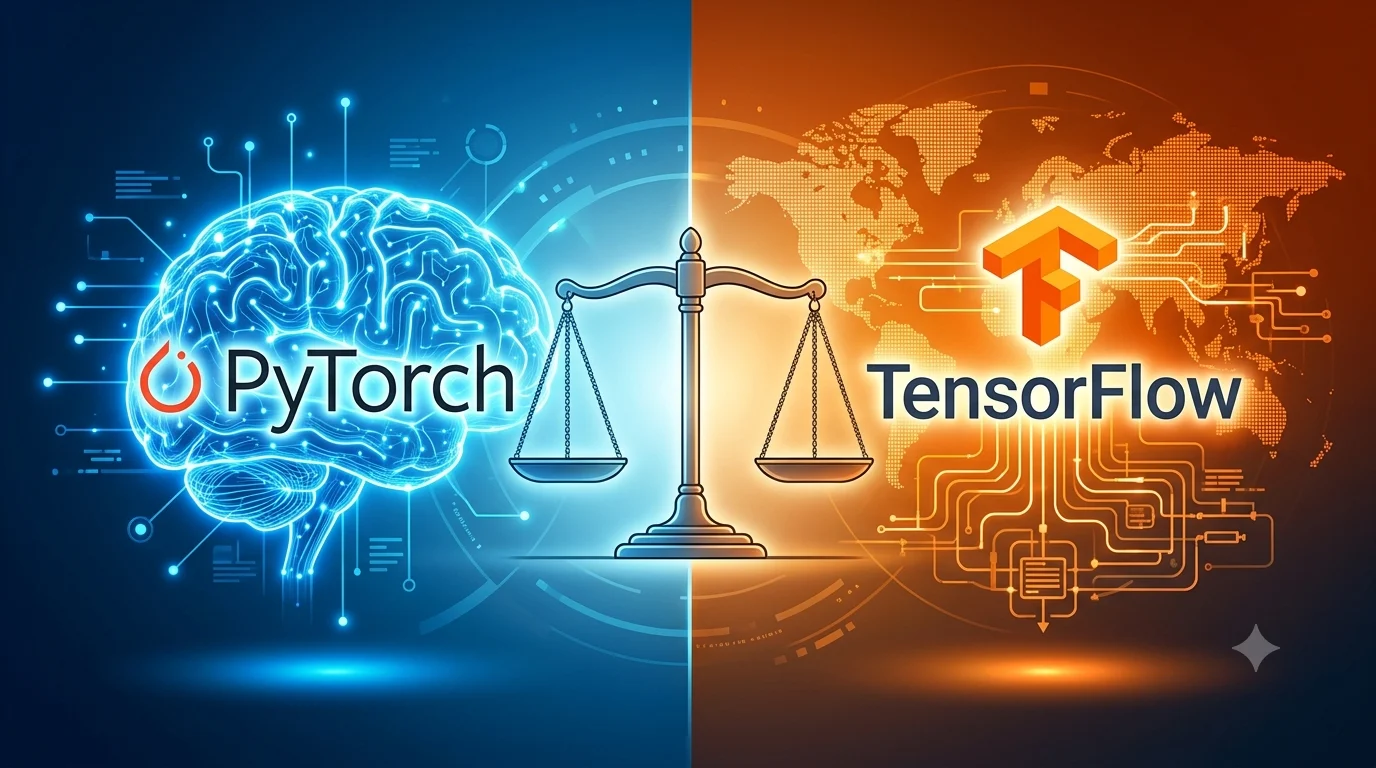
🤔 If you have ever typed “what is pytorch vs tensorflow” into a search bar, you are not alone. Every day, thousands of AI beginners, researchers, and tech leads search for this exact question. The world of deep learning moves fast, and choosing the wrong framework can waste months of work.
This guide gives you the complete picture. We will break down the PyTorch vs TensorFlow differences, compare their performance, look at the popularity 2024 survey data, see how trends shifted in 2025, and tell you exactly what to expect in 2026. We will also clear up the confusion around PyTorch vs TensorFlow vs Keras.
By the end, you will know precisely which tool fits your project, your team, and your career goals.
PyTorch vs TensorFlow
PyTorch is the undisputed king of AI research, while TensorFlow remains the champion of large-scale production and mobile deployment.
Here is the simplest rule:
- Pick PyTorch if you are experimenting, reading modern research papers, or using large language models (LLMs).
- Pick TensorFlow if you are shipping a product to millions of users, working on mobile apps, or using Google Cloud TPUs.
Example: A PhD student testing a new neural network architecture uses PyTorch. A software engineer building an Android app with on-device AI uses TensorFlow Lite.
PyTorch vs TensorFlow Comparison – The Key Differences
To understand these frameworks, you need to know their core differences. Here is the breakdown:
| Feature | PyTorch | TensorFlow |
|---|---|---|
| Graph Type | Dynamic (builds as you run) | Static + Eager Execution |
| Debugging | Easy (use standard Python print) | Harder (needs special tools) |
| Research Use | ~85% of all AI papers | ~15% of all AI papers |
| Production Use | Improving, but less mature | Industry standard (TF Serving, Lite) |
| Learning Curve | Gentle (feels like Python) | Steep (takes more time) |
| Mobile Support | PyTorch Mobile | TensorFlow Lite (much better) |
The main difference is philosophy. PyTorch is built for flexibility. TensorFlow is built for stability and scale.
PyTorch vs TensorFlow Performance – Which is Faster?
When we look at PyTorch vs TensorFlow performance, both are incredibly fast. In 2024, benchmarks showed them neck-and-neck on NVIDIA GPUs.
However, there is a catch:
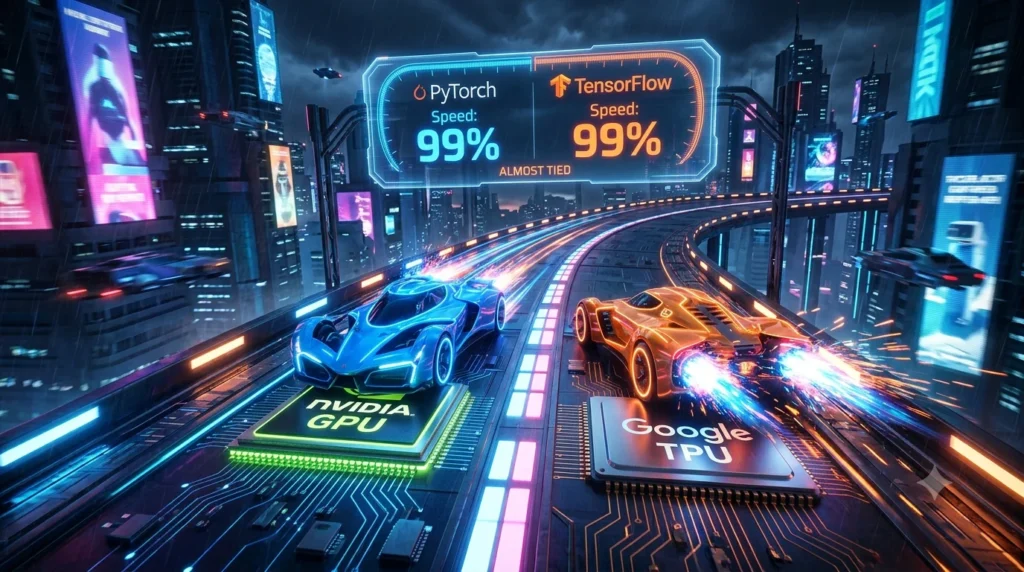
- TensorFlow runs better on Google’s custom TPU chips. If you use Google Cloud, TensorFlow wins on raw speed.
- PyTorch often runs faster on standard NVIDIA GPUs for dynamic models (like transformers) because it compiles the graph on the fly.
Verdict: For 95% of users, the performance gap is too small to matter. Choose based on features, not speed.
PyTorch vs TensorFlow vs Keras – Untangling the Mess
Many people get confused about PyTorch vs TensorFlow vs Keras. Here is the truth:
- TensorFlow is the full deep learning ecosystem.
- Keras is a high-level API (a user-friendly wrapper) that runs on top of TensorFlow.
- PyTorch is a separate framework that competes directly with TensorFlow.
Big news for 2025/2026: Keras 3.0 now runs on TensorFlow, PyTorch, and JAX! This means you can write Keras code and run it on either backend.
If you are a beginner, learning Keras with TensorFlow is a good start. But if you want to work in cutting-edge AI research, PyTorch is the clear winner. The keras vs pytorch vs tensorflow debate is now less intense because they are starting to work together.
PyTorch vs TensorFlow Popularity 2024 vs 2025 vs 2026
Let’s look at the cold, hard numbers. This is the most asked question: pytorch vs tensorflow popularity 2024, 2025, and 2026.
📊 Popularity in 2024
- Research: PyTorch dominated with ~80% of papers at top conferences like NeurIPS and ICML.
- Industry: TensorFlow still led with a 40% market share vs PyTorch’s 22%.
- Survey: A popularity 2024 survey showed that 65% of new ML students chose PyTorch as their first framework.
📈 Popularity in 2025
- The PyTorch vs TensorFlow comparison 2025 showed a major shift. PyTorch closed the industry gap significantly.
- PyTorch downloads hit 40 million per month (up from 25M in 2023).
- TensorFlow maintained its lead in enterprise, but PyTorch became the default for startups.
- Reddit threads on pytorch vs tensorflow popularity 2025 heavily favored PyTorch for new projects.
🚀 Popularity in 2026 (Current Trend)
- Right now, in the PyTorch vs TensorFlow 2026 comparison, the race is tighter than ever.
- PyTorch holds ~25.7% market share, TensorFlow holds ~37.5%.
- However, 85% of generative AI (LLM) projects use PyTorch via the Hugging Face library.
- For PyTorch vs TensorFlow popularity 2025 2026, the trend line shows PyTorch growing faster. The pytorch vs tensorflow popularity 2024 2025 data proves that PyTorch is the momentum winner.
📊 Summary of Popularity Trends:
- 2024: TensorFlow wins industry, PyTorch wins research.
- 2025: PyTorch catches up in industry.
- 2026: PyTorch leads in AI/LLM, TensorFlow leads in mobile/enterprise.
PyTorch vs TensorFlow Comparison Over the Years (2024 vs 2025 vs 2026)
Let’s do a side-by-side PyTorch vs TensorFlow 2024 comparison versus 2025 comparison versus 2026 comparison:

| Aspect | 2024 Comparison | 2025 Comparison | 2026 Comparison |
|---|---|---|---|
| Research Dominance | PyTorch (80%) | PyTorch (83%) | PyTorch (85%) |
| Production Tools | TensorFlow | TensorFlow (still better) | Gap is narrowing |
| Beginner Choice | 60% pick PyTorch | 68% pick PyTorch | 72% pick PyTorch |
| Job Postings | TensorFlow 35% vs PyTorch 30% | TensorFlow 33% vs PyTorch 35% | TensorFlow 32% vs PyTorch 37% |
| Mobile/Edge | TensorFlow wins | TensorFlow wins | TensorFlow wins (2.7B devices) |
The PyTorch vs TensorFlow 2026 comparison shows that the gap in industry is closing fast. If you are starting your career now, PyTorch gives you a slight edge in job postings.
Which One Should You Choose? (Audience-Based Advice)
Choose PyTorch if you are:
- 🎓 A student or researcher reading modern papers.
- 🤖 Building a chatbot or LLM (using Hugging Face).
- 🐍 A Python lover who hates boilerplate code.
- 🚀 Working in a startup or agile environment.
- 📊 Looking at trends (the popularity 2025 2026 data favors PyTorch for future growth).
Choose TensorFlow if you are:
- 🏢 Deploying AI to millions of users in a corporate setting.
- 📱 Building an Android or iOS app with AI features.
- ☁️ Deeply invested in Google Cloud and TPUs.
- ⚙️ Need advanced production monitoring (TensorBoard, TFX).
- 📉 Working in a traditional enterprise that values stability over novelty.
Common Mistakes When Choosing
❌ Mistake 1: “TensorFlow is dead.”
✅ Correction: No. It has 25,000+ companies using it. It is huge.
❌ Mistake 2: “PyTorch can’t go to production.”
✅ Correction: It can. Many companies (like Meta and Tesla) use PyTorch in production.
❌ Mistake 3: “I must learn only one.”
✅ Correction: Learn one deeply, but know the basics of the other. Employers love versatility.
❌ Mistake 4: “The 2024 data doesn’t matter now.”
✅ Correction: It does! The popularity 2024 survey sets the baseline for current hiring trends.
PyTorch vs TensorFlow in Everyday Examples

- On Reddit: “Just got my first ML job. They use PyTorch. The pytorch vs tensorflow reddit threads were right – it is easier!”
- In a Job Interview: “Our company uses TensorFlow for our recommendation engine, but we allow PyTorch for research prototypes.”
- In a News Headline: “PyTorch dominates the 2025 AI conference papers, while TensorFlow maintains enterprise lead.”
- In Academic Writing: “For our PyTorch vs TensorFlow comparison 2025 study, we found that PyTorch reduced coding time by 30%.”
Frequently Asked Questions
1. Does GPT use TensorFlow or PyTorch?
OpenAI uses PyTorch for GPT-4 and most of their large language models. They switched from TensorFlow years ago.
2. What is PyTorch vs TensorFlow in simple terms?
PyTorch is like writing normal Python code – flexible and easy to test. TensorFlow is like a robust factory machine – built for heavy production.
3. Is TensorFlow losing to PyTorch?
In research, yes. In industry, no. The pytorch vs tensorflow popularity 2024 2025 data shows PyTorch is winning the mindshare, but TensorFlow is winning the marketshare.
4. Which is easier for a complete beginner?
PyTorch is easier. It feels like standard Python. TensorFlow has more “magic” functions that confuse new coders.
5. Should I learn PyTorch or TensorFlow in 2026?
If you want to work in AI research or modern startups, learn PyTorch. If you want to work in large banks, retail, or mobile apps, learn TensorFlow. Ideally, learn both!
6. How does Keras fit into this in 2026?
Keras 3.0 can use TensorFlow or PyTorch as its backend. So you can use Keras and switch between them easily.
7. What was the popularity survey like in 2024?
A major popularity 2024 survey showed that PyTorch was preferred by 70% of academics, while TensorFlow was preferred by 60% of industry engineers.
8. Is performance really different between them?
No. For 99% of tasks, the performance is identical. Pick based on how easy the code is to write.
Conclusion
So, what is the final answer to PyTorch vs TensorFlow?
The data from 2024, 2025, and 2026 tells one clear story: PyTorch is the future of research and AI innovation, but TensorFlow is the safe bet for large-scale enterprise systems.
If you are reading this as a beginner, start with PyTorch. It is simpler, the popularity is skyrocketing, and it teaches you the core concepts of deep learning without unnecessary complexity. However, keep an eye on TensorFlow – its production tools are unmatched, and it runs on billions of devices worldwide.
Don’t stress about making the “wrong” choice. The concepts you learn in one transfer directly to the other. The best framework is the one that gets your project done faster. Looking at the PyTorch vs TensorFlow 2026 comparison, both are getting better and easier to use.
Choose PyTorch for flexibility. Choose TensorFlow for scale. Choose both for a winning career!

Barbara Pym was an English novelist known for her witty, observant stories of everyday life, blending humor and quiet emotion with sharp social insight.