Have you ever paused while typing “saucy” and wondered if it should be “saucey” instead? You are not alone. Every single day, thousands of people search for saucey or saucy meaning because this small spelling difference causes big confusion. Some people see the word “sauce” and simply add a “y”. Others remember seeing it spelled both ways online and feel unsure which one is right for their writing.
This article solves that confusion once and for all. We will explain the saucy or saucy pronunciation, give you a clear saucy or saucy synonym list, and show you exactly how to use saucy or saucy in english without any doubt. Whether you are writing a food blog, a flirty text message, or a professional email, you will leave this page knowing the correct choice.
Let us clear up the mess around this spicy little word.
Saucey vs Saucy
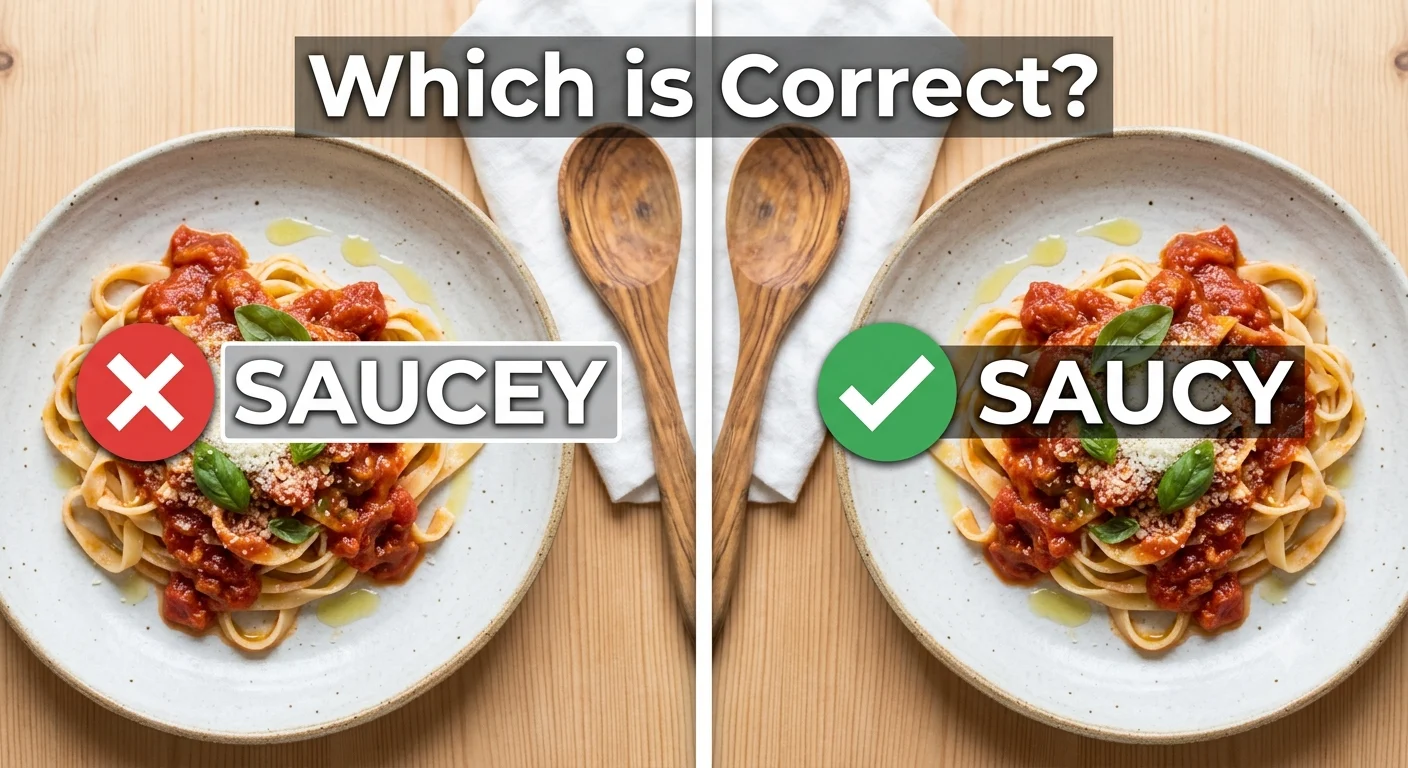
The correct spelling is saucy. The spelling saucey is a mistake and does not exist in any standard English dictionary.
Here is a simple breakdown:
| ✅ Correct Spelling | ❌ Incorrect Spelling |
|---|---|
| saucy | saucey |
Examples in sentences:
- ✅ “That pasta dish is wonderfully saucy.”
- ❌ “That pasta dish is wonderfully saucey.” (Wrong)
- ✅ “She gave him a saucy wink across the room.”
- ❌ “She gave him a saucey wink.” (Wrong)
So, what does saucy mean? It has three main uses:
- Cheeky or playfully rude – “He made a saucy comment.”
- Flirtatious or bold – “She wore a saucy red dress.”
- Containing or covered with sauce – “These are saucy meatballs.”
If you ever ask yourself is it saucy or saucey?, just remember: drop the ‘e’ from sauce and add a ‘y’. Always choose saucy.
The Real Origin of “Saucy”
Understanding where a word comes from helps you remember its correct spelling. The word saucy first appeared in the English language around the year 1500. It comes from the noun sauce combined with the adjective suffix -y, which means “having the quality of”.
At first, saucy had a very literal meaning. It simply meant “resembling sauce” or “having a lot of sauce”. But language is alive, and words change over time. By the 1520s, something interesting happened. People started using saucy to describe a person who was bold, impudent, or playfully disrespectful.

Why did the meaning shift? Think about cooking. Sauce adds flavor, kick, and excitement to plain food. In the same way, a saucy person adds excitement and attitude to a conversation. They are not boring; they are full of flavor. This connection made the word stick, and it has been used this way for over 500 years.
The misspelling saucey likely started because people saw the root word sauce and added the *-y* without knowing the rule. This is a common error in English, especially for words ending in a silent *e*. However, saucy is an exception to the normal rule, which makes it tricky for learners and native speakers alike.
British vs American English – Is There a Difference?
Here is some good news: there is no difference between British and American English for this word. Both regions spell it exactly the same way: saucy.
| Feature | British English | American English |
|---|---|---|
| Spelling | saucy | saucy |
| Incorrect Spelling | saucey (never used) | saucey (never used) |
| Primary Meaning | Cheeky, risqué, or full of sauce | Cheeky, flirtatious, or saucy food meaning |
While the spelling is identical, the pronunciation has a slight variation.
- British Pronunciation: /ˈsɔː.si/ – Sounds like “saw-see” with a long ‘aw’ sound.
- American Pronunciation: /ˈsɑː.si/ or /ˈsɔː.si/ – Sounds like “sah-see” or “saw-see”.
What about usage? There is a subtle cultural difference. In British English, saucy is heavily associated with cheeky humor, seaside postcards, and playful rudeness. In American English, people often use sassy more frequently for attitude, while saucy leans more toward flirtatiousness or describing rich, flavorful food. However, both audiences will understand you perfectly if you use the correct spelling.
Which Spelling Should You Choose?
Choosing the right spelling depends entirely on your audience and context. Here is a simple guide to follow every time.
For American Readers
Always use saucy. It is the only accepted form in the US. Whether you are writing a blog post about saucy food meaning or describing a character’s personality, this is your only choice.

For British and Commonwealth Readers
Always use saucy. The UK, Australia, Canada, and other English-speaking nations do not recognize saucey as a valid word. Stick with the traditional spelling.
For Global or International Writing
Always use saucy. Since this is the dictionary standard, it is the safest and most professional choice for any international audience.
The Only Exception
There is one tiny exception. Some companies use Saucey as a brand name. For example, there is an alcohol delivery service called Saucey. If you are specifically writing about that brand, you should capitalize it and spell it their way. However, for the adjective meaning cheeky, flirtatious, or covered in sauce, saucy is the undisputed winner.
Common Mistakes People Make
Even experienced writers make errors with this word. Here are the most frequent mistakes and how to fix them.
Mistake 1: Adding an ‘e’ before ‘y’
- ❌ Wrong: “She is a saucey girl.”
- ✅ Correct: “She is a saucy girl.”
- Explanation: Always drop the silent ‘e’ from sauce.
Mistake 2: Confusing ‘saucy’ with ‘sassy’
- ❌ Wrong: “He gave a sassy wink” (when you mean flirtatious).
- ✅ Correct: “He gave a saucy wink.”
- Explanation: Saucy often implies flirtation or mild spice. Sassy implies bold attitude without the romantic or flirtatious tone.
Mistake 3: Overusing it for food
When you describe a dish as saucy, it simply means it has a lot of sauce. However, in some cooking contexts, it can also mean the sauce is too thin or runny. Be clear about your meaning.
Mistake 4: Misspelling the comparative forms
- ❌ Wrong: “That dish is more saucey.”
- ✅ Correct: “That dish is saucier.”
- ❌ Wrong: “That is the sauceiest.”
- ✅ Correct: “That is the sauciest.”
Mistake 5: Using it negatively without context
While saucy is usually playful, calling someone saucy in a very formal setting might sound rude. Always consider your audience.
Waiving vs Waving – A Quick Bonus Tip!
Many people confuse these two words just like saucey and saucy. Since you asked, here is the answer.
Is it waiving a fee or waving a fee?
The correct phrase is waiving a fee.
- Waive (verb) means to give up or refrain from enforcing a rule, right, or fee. When a bank waives your late fee, they cancel it. You do not have to pay it.
- Wave (verb) means to move your hand back and forth to greet someone or to signal.
Examples:
- ✅ “The company is waiving the registration fee this month.” (They are canceling it)
- ❌ “The company is waving the registration fee.” (This means they are moving their hands over the fee – it makes no sense)
- ✅ “She stood on the stage and started waving at the crowd.”
Remember: Waive = cancel/remove. Wave = move hand or signal. So, always use waiving a fee.
Saucey vs Saucy in Real-Life Examples
Let us see how saucy looks in different types of writing. This will help you use it naturally.
In Emails (Informal)
- “I love your saucy signature at the end of your emails!”
- “That was a saucy reply to the client’s question. I hope they took it well.”

In News Headlines and Journalism
- “The chef’s new cookbook features saucy recipes from around the world.”
- “The politician gave a saucy response to the reporter’s tough question.”
On Social Media (Instagram, Twitter, TikTok)
- “Feeling saucy tonight. 💃”
- “This dress is giving saucy vibes.”
- “Saucy food meaning: when your pasta looks like a work of art.”
In Formal or Academic Writing
- “The character’s saucy wit makes her the most memorable figure in the play.”
- “The dish was served with a rich, saucy tomato reduction.”
Describing People and Personalities
- Saucy girl meaning: A young woman who is bold, confident, and playfully flirty.
- Saucy person meaning: Anyone who has a sharp tongue and a fearless, charming attitude.
- Example: “She is a saucy person who always says what others are thinking.”
Google Trends and Popularity
Search data shows that saucy is significantly more popular than saucey in every English-speaking country. The misspelling saucey does get searched, but mostly by people trying to verify the correct spelling.
- United States: Saucy is very common, especially in food blogs and lifestyle content. However, sassy often competes with it.
- United Kingdom: Saucy holds a special place in British culture. It is linked to classic British humor.
- Australia and Canada: Both follow the UK pattern and use saucy almost exclusively.
The searches related to this topic usually include:
- saucey or saucy meaning – Definition seekers.
- saucy or saucy pronunciation – People wanting to say it right.
- saucy or saucy synonym – Writers looking for alternatives like cheeky or flirtatious.
- saucy or saucy in english – Non-native speakers learning the rules.
Interestingly, searches for what does saucy mean in food? spike during holiday seasons like Thanksgiving and Christmas, when rich, sauce-heavy meals are prepared. Searches for does saucy mean flirty? peak around Valentine’s Day.
Comparison Table
Here is a side-by-side comparison of the two spellings to help you decide at a glance.
| Feature | Saucy (Correct) | Saucey (Incorrect) |
|---|---|---|
| Dictionary Status | Found in all major dictionaries | Not found in any dictionary |
| Spelling Rule | Drop the ‘e’ from sauce | Keeps the ‘e’ from sauce |
| Meaning | Cheeky, flirtatious, or saucy food meaning | No meaning (misspelling) |
| Usage in Writing | Used everywhere (formal, casual) | Should be avoided completely |
| Comparative Form | saucier | N/A |
| Superlative Form | sauciest | N/A |
| Brand Exception | No | Yes (only as a proper name) |
Frequently Asked Questions
1. Is “saucey” a real word?
No. Saucey is not a real word in standard English. It is a common misspelling. The correct spelling is saucy. The only time you might see Saucey is if it is a brand name or a surname.
2. What does saucy mean in food?
Saucy food meaning is simple: it describes food that has a lot of sauce or is very moist and flavorful. For example, “These saucy barbecue ribs are amazing.” It can also sometimes mean the sauce is too runny, but usually, it is a compliment.
3. Does saucy mean flirty?
Yes, absolutely. One of the most common uses of saucy is to describe someone who is boldly flirtatious, playful, or teasing. A saucy smile or a saucy comment usually carries a flirty undertone.
4. Is it saucy or saucey in British English?
It is saucy in British English. The British do not use saucey at all. The spelling is the same in both UK and US English.
5. What is the difference between saucy and sassy?
Saucy often implies flirtatiousness, cheekiness, or mild sexual tension. Sassy implies boldness, attitude, and spirited disrespect without the flirtatious element. For instance, a child might be sassy to their parents, but you would not call them saucy.
6. What does saucy girl mean?
A saucy girl is a young woman who is confident, bold, playfully cheeky, and often flirtatious. It is usually used as a compliment to describe her lively and attractive personality.
7. How do you pronounce “saucy”?
In British English, it is pronounced /ˈsɔːsi/ (saw-see). In American English, it can be /ˈsɔːsi/ (saw-see) or /ˈsɑːsi/ (sah-see). Both pronunciations are correct.
8. What are synonyms for saucy?
Common synonyms include: cheeky, sassy, impudent, flirtatious, pert, playful, bold, and perky.
9. Is it waiving a fee or waving a fee?
It is waiving a fee. Waive means to cancel or give up a right or fee. Wave means to move your hand. So, a bank waives your late fee; it does not wave it.
10. Can I use “saucy” in a professional email?
It depends on the context. If you are writing a casual email to a colleague you know well, it is fine. However, for formal business correspondence, it is better to use professional words like bold, playful, or rich instead.
Conclusion
After reading this complete guide, you should never have to wonder about saucey vs saucy again. The answer is clear and simple: saucy is always the correct spelling. Saucey is a misspelling that has no place in proper English writing.
We have explored the rich history of this word, from its literal meaning of “resembling sauce” in the 1500s to its modern use as a compliment for a bold, flirtatious, or cheeky personality. We have also confirmed that the spelling does not change between British and American English, making it an easy rule to remember.
Additionally, we clarified the common confusion around waiving vs waving. Always remember: waive means to cancel, and wave means to move your hand.
Whether you are writing a food article using saucy food meaning, describing a saucy girl meaning in a story, or just sending a playful text, use saucy with confidence. It adds spice to your language and shows that you have a good command of English spelling. So go ahead and write that saucy sentence today!

Mark Twain was an American author celebrated for his humor, sharp social commentary, and adventurous stories that captured the spirit and voice of everyday life.