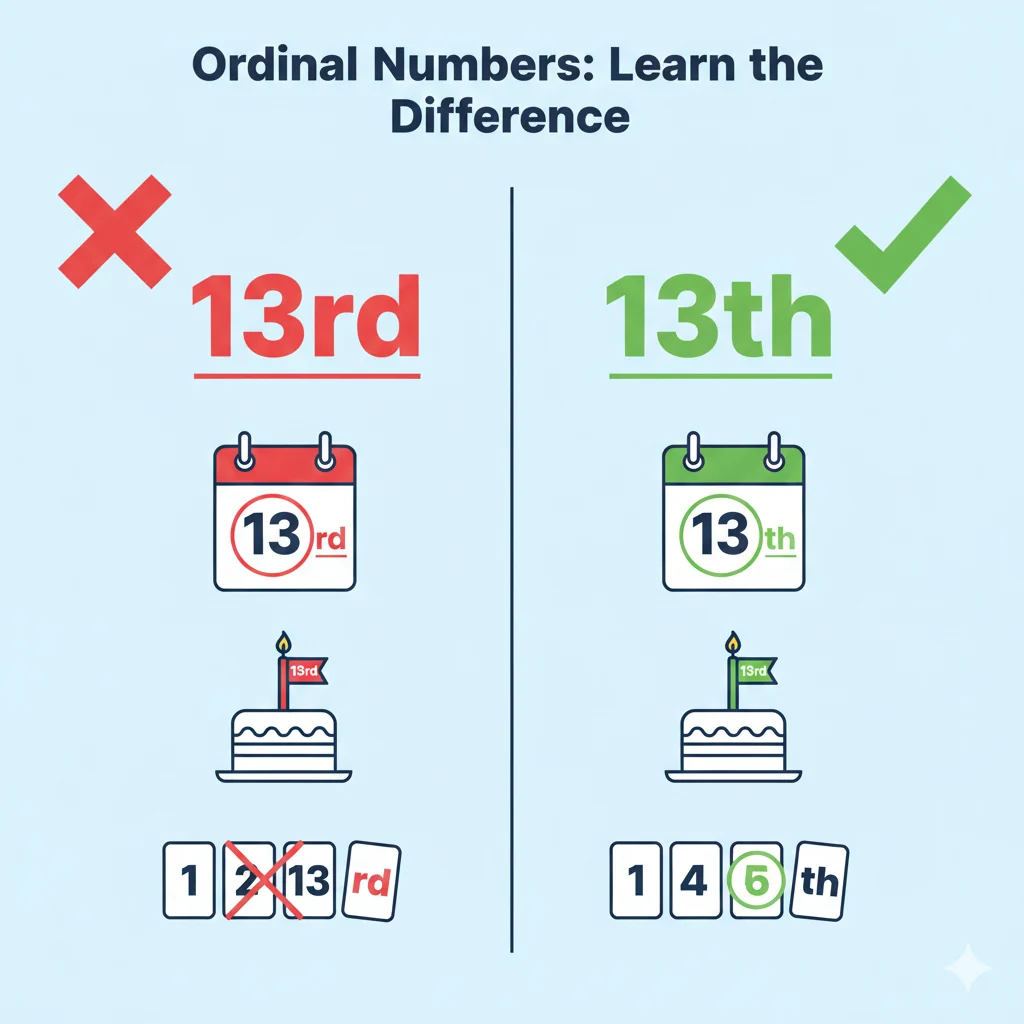
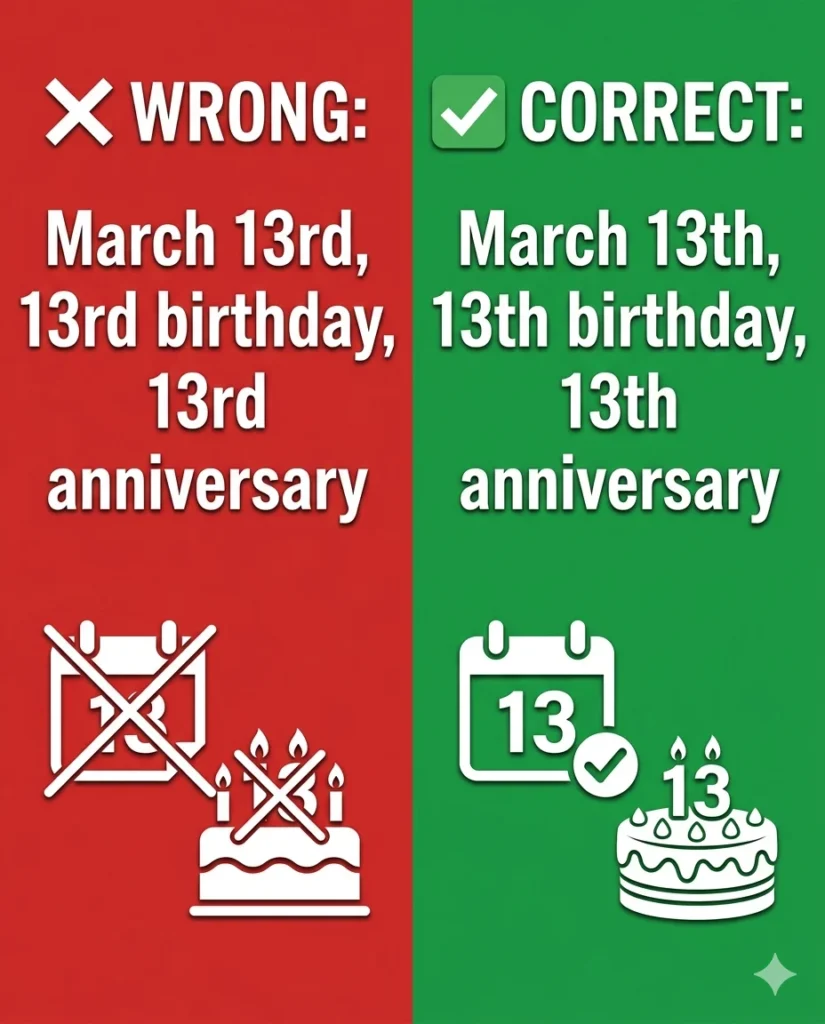
Confused between 13rd vs 13th? The correct spelling is 13th, and “13rd” is grammatically incorrect in English.
This confusion happens because people follow the pattern of 3rd and assume 13 should become 13rd. However, English ordinal numbers follow a specific grammar rule. While 1 takes “st,” 2 takes “nd,” and 3 takes “rd,” numbers from 11 to 19 always use “th.” That means 11th, 12th, and 13th are all correct forms.
Using 13rd in birthdays, dates, anniversaries, or academic writing can make your content look unprofessional and incorrect. Understanding this simple rule helps you avoid common grammar mistakes and improve your English usage.
In this guide, you’ll learn the correct spelling, the ordinal number rule, practical examples, and easy memory tricks to never confuse 13rd and 13th again.
Do We Say 13rd or 13th?
We always say and write 13th.
13rd does not exist in English grammar.
| Correct (✅) | Incorrect (❌) |
|---|---|
| June 13th | June 13rd |
| My 13th birthday | My 13rd birthday |
| 13th anniversary | 13rd anniversary |
| March 13th | March 13rd |
| November 13th | November 13rd |
| February 13th | February 13rd |
| 13th of January | 13rd of January |
| 13th August | 13rd August |
Remember: Only the number 3 uses “rd”. The number 13 uses “th” like all other teenagers (13th, 14th, 15th…).
What Is the Meaning of 13th vs 13rd?
13th means the ordinal form of thirteen – it tells the position (thirteenth) in a sequence. For example: the thirteenth day, the thirteenth person, the thirteenth floor.
13rd has no meaning. It is an incorrect spelling that some people create by copying the pattern from “3rd”. But English does not allow “13rd” in any context – not in American English, not in British English, not in any formal or informal writing.
Is 13 th or rd?
Answer: 13th. There is no “13rd”.
Why Do People Write “13rd”? (The Origin of the Mistake)
The mistake comes from overgeneralizing. We learn:
- 1 → 1st
- 2 → 2nd
- 3 → 3rd
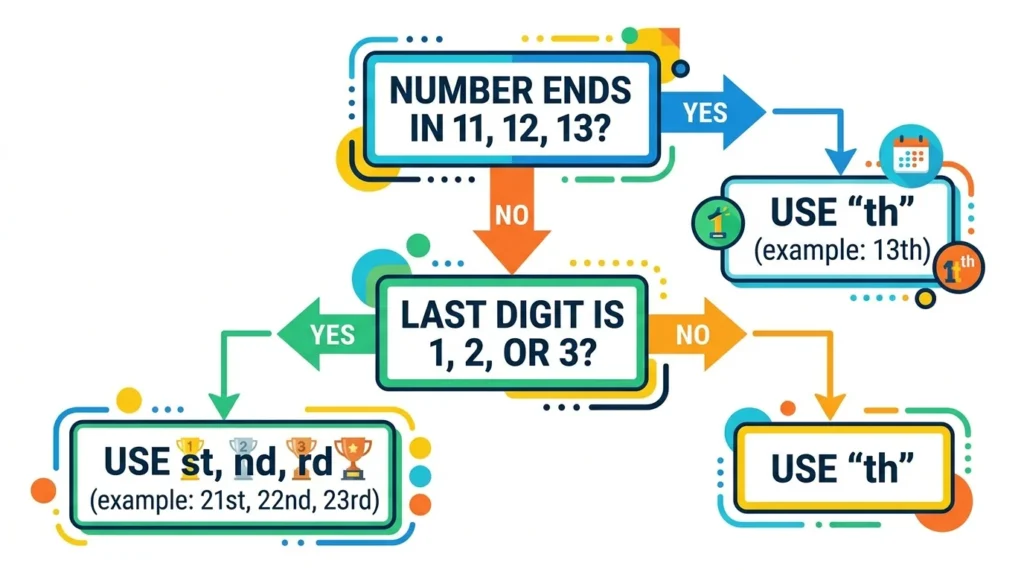
Then when we reach 13, our brain thinks: “13 ends with 3, so it should be 13rd.” But this is wrong because numbers from 11 to 19 always end with “th” – even if they end with 1, 2, or 3.
Think of it this way:
- 11th (not 11st)
- 12th (not 12nd)
- 13th (not 13rd)
The Simple Rule for All Ordinal Numbers (With Examples)
Rule 1: Numbers ending in 1, 2, 3 (except 11, 12, 13)
| Number | Correct Ordinal | Common Mistake |
|---|---|---|
| 1 | 1st | 1th ❌ |
| 2 | 2nd | 2th ❌ |
| 3 | 3rd | 3th ❌ |
| 21 | 21st | 21th ❌ |
| 22 | 22nd | 22th ❌ |
| 23 | 23rd | 23th ❌ |
| 31 | 31st | 31th ❌ |
| 32 | 32nd | 32th ❌ |
| 33 | 33rd | 33th ❌ |
Rule 2: Numbers ending in 11, 12, 13 ALWAYS use “th”
| Number | Correct Ordinal | Common Mistake |
|---|---|---|
| 11 | 11th | 11st ❌ |
| 12 | 12th | 12nd ❌ |
| 13 | 13th | 13rd ❌ |
| 111 | 111th | 111st ❌ |
| 212 | 212th | 212nd ❌ |
| 313 | 313th | 313rd ❌ |
Rule 3: All other numbers use “th”
| Number | Correct Ordinal |
|---|---|
| 4th, 5th, 6th, 7th, 8th, 9th, 10th | th |
| 14th, 15th, 16th, 17th, 18th, 19th | th |
| 20th, 30th, 40th, 100th, 1000th | th |
Clarifying “23th vs 13rd” (Common Confusion)
You might see both mistakes online. Here is the difference:
| Wrong Form | Why It’s Wrong | Correct Form |
|---|---|---|
| 23th | Number 23 ends with 3, but it is NOT a “teen” number (23 = twenty-three). It should take “rd” like 3rd. | 23rd |
| 13rd | Number 13 IS a “teen” number (thirteen). Teen numbers always take “th”. | 13th |
Simple memory trick:
- If the number ends with “teen” (13,14,15,16,17,18,19) → use th
- If the number ends with 3 but NOT “teen” (3,23,33,43…) → use rd
Real-Life Examples: Birthdays, Anniversaries, and Dates
13rd or 13th Birthday?
Correct: “Happy 13th birthday!”
Incorrect: “Happy 13rd birthday!”
13rd or 13th Anniversary?
Correct: “We celebrated our 13th anniversary.”
Incorrect: “We celebrated our 13rd anniversary.”
March 13th or 13rd?
Correct: “The event is on March 13th.” (US) or “13th March” (UK)
Incorrect: “March 13rd” (anywhere)
November 13th or 13rd?
Correct: “November 13th is the deadline.”
Incorrect: “November 13rd”
February 13th or 13rd?
Correct: “February 13th is my friend’s birthday.”
Incorrect: “February 13rd”
Is it 13th or 13rd of January?
Correct: “The meeting is on the 13th of January.”
Incorrect: “13rd of January”
Is it 13th or 13rd August?
Correct: “13th August” (British style) or “August 13th” (American)
Incorrect: “13rd August”
What about 12th or 13rd?
- 12th is correct (12th birthday, 12th anniversary)
- 13rd is wrong. The correct form is 13th.
Month-by-Month Reference Table
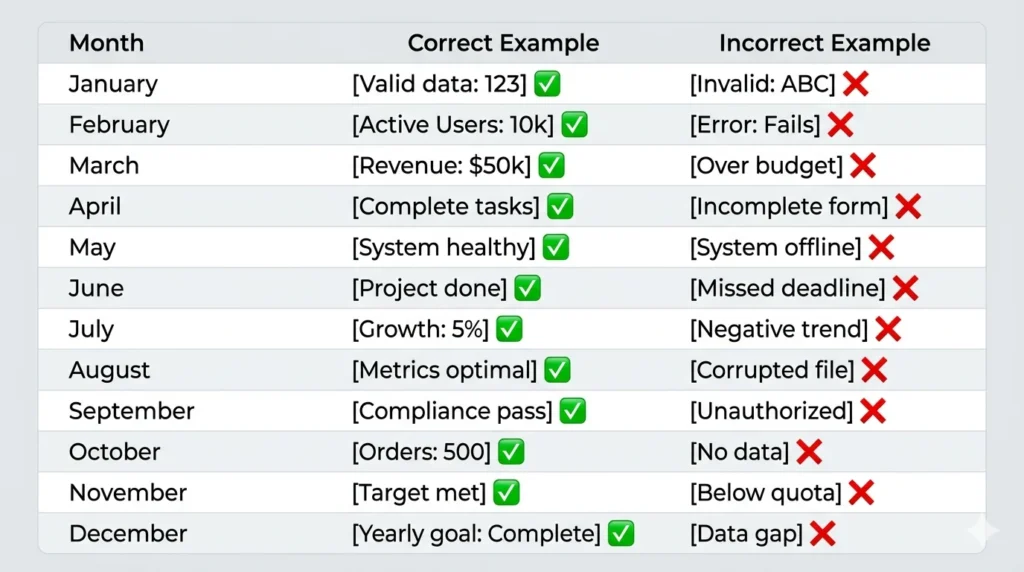
| Month | Correct Example | Incorrect Example |
|---|---|---|
| January | January 13th / 13th January | January 13rd ❌ |
| February | February 13th / 13th February | February 13rd ❌ |
| March | March 13th / 13th March | March 13rd ❌ |
| April | April 13th / 13th April | April 13rd ❌ |
| May | May 13th / 13th May | May 13rd ❌ |
| June | June 13th / 13th June | June 13rd ❌ |
| July | July 13th / 13th July | July 13rd ❌ |
| August | August 13th / 13th August | August 13rd ❌ |
| September | September 13th / 13th September | September 13rd ❌ |
| October | October 13th / 13th October | October 13rd ❌ |
| November | November 13th / 13th November | November 13rd ❌ |
| December | December 13th / 13th December | December 13rd ❌ |
Memory Tricks to Never Forget (For Adults and Students)
Trick 1: “Teen means th”
Any number that ends with “teen” (13, 14, 15, 16, 17, 18, 19) takes “th”.
13 is thirteen → 13th.
Trick 2: The “Eleven, Twelve, Thirteen” Exception
Say this out loud: “Eleventh, twelfth, thirteenth.” They all end with “th”. Never “thirteenrd”.
Trick 3: Visualize the floor
If a building has a 13th floor, they never write “13rd floor”. That looks strange. Trust your eyes – only “13th floor” looks normal.
Trick 4: Compare 3 vs 13
- 3 → 3rd (special because it is a single digit 3)
- 13 → 13th (because it is a ‘teen’ number)
Common Mistakes in Everyday Writing (And How to Fix Them)
| Situation | Wrong (❌) | Correct (✅) |
|---|---|---|
| Birthday invitation | “Join us for my 13rd birthday” | “Join us for my 13th birthday” |
| Work email | “Please submit by November 13rd” | “Please submit by November 13th” |
| School assignment | “The project is due March 13rd” | “The project is due March 13th” |
| Social media caption | “Can’t wait for Feb 13rd” | “Can’t wait for Feb 13th” |
| Formal letter | “The contract ends on 13rd June” | “The contract ends on 13th June” |
Pro tip: If you are ever unsure, write the word instead of the number: “thirteenth” is always safe.
Is “13rd” Ever Acceptable in Any Dialect?
No. Not in American English. Not in British English. Not in Australian, Canadian, or Indian English. Even informal writing like text messages or social media does not accept “13rd”. It is simply a grammar error.
Some people search “13th o 13rd” (Spanish or Italian influence) – the answer is always 13th.
Quick Quiz: Test Yourself
Choose the correct option:
- My birthday is on (June 13rd / June 13th).
- We are celebrating our (13rd / 13th) anniversary.
- The deadline is (March 13rd / March 13th).
- Is it (13th or 13rd) of January?
- She turned (13rd / 13th) last week.
- Which is correct: (23th / 23rd)?
- Which is correct: (12th / 12nd)?
Answers: 1. June 13th, 2. 13th, 3. March 13th, 4. 13th, 5. 13th, 6. 23rd, 7. 12th
You Might Also Like (Related Grammar Guides)
If you found this helpful, check out these articles:
- 1st vs 1th – Which is Correct?
- 2nd vs 2th – Grammar Rule Explained
- 21st vs 21th – Common Mistake
- Ordinal Numbers: Complete Guide for Dates
(Add your own internal links here if you have these articles.)
Conclusion
In conclusion, the correct usage is always 13th, never 13rd. Miswriting ordinals is common but easily corrected by remembering the simple rule: 1st, 2nd, 3rd → -st, -nd, -rd; all others → -th. Whether writing June 13th or 13th June, October 13th, or 12th or 13th, sticking to 13th ensures clarity and professionalism.
This knowledge is essential for writing emails, formal documents, social media posts, school assignments, and news articles. By following British and American conventions, you can address your audience accurately while avoiding common mistakes. Understanding 13rd vs 13th helps your writing stay credible and grammatically correct, making your communication precise and reader-friendly.

E.M. Forster was an English novelist celebrated for his insightful stories about class, connection, and humanity, blending gentle humor with deep social themes.