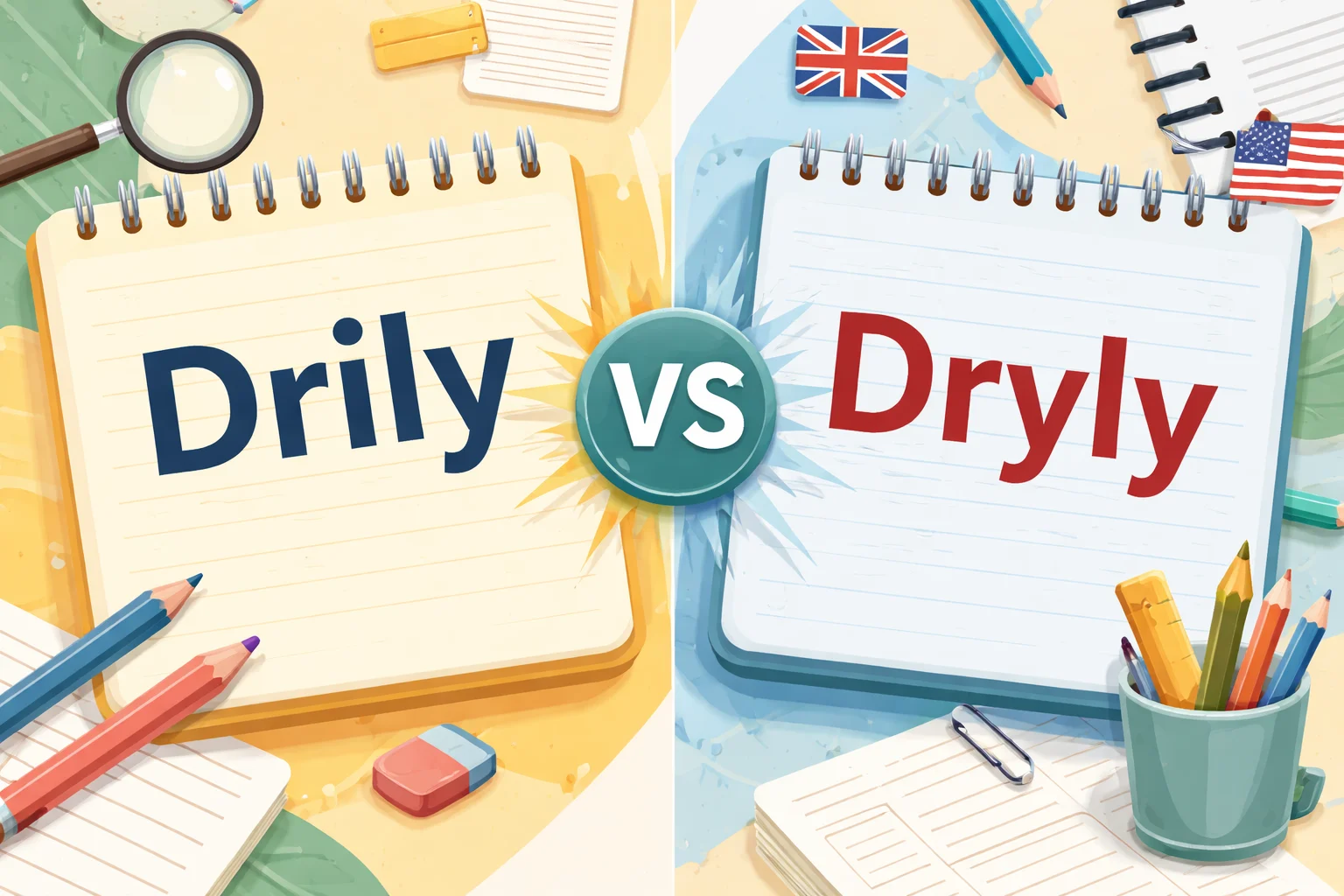
Confused about Drily vs Dryly? Both words are correct spellings of the same adverb, meaning in a dry, matter-of-fact, ironic, or unemotional manner. The difference is primarily regional and stylistic rather than grammatical. Dryly is the more common spelling in modern American and British English, while drily is considered a traditional variant that still appears in dictionaries and published writing.
Whether you’re writing an essay, email, blog post, or professional document, knowing which spelling to use helps improve clarity and consistency. Many writers also search for the pronunciation, meaning, examples, grammar rules, and regional preferences before deciding which form fits their audience.
In this guide, you’ll learn the difference between Drily and Dryly, their meanings, origins, pronunciation, usage in American and British English, common mistakes, everyday examples, and when each spelling is the better choice. By the end, you’ll know exactly which spelling to use with confidence. ✨
Drily vs Dryly
Short Explanation
The standard and widely accepted form is dryly. It is the adverb form of dry, which describes something said in a matter-of-fact, understated, or wry manner.
- ✔️ She dryly remarked that the instructions were unclear.
- ✔️ He dryly observed the chaos in the meeting room.
Drily exists as a historical variant but is rarely used today and is generally considered nonstandard.
Examples Side by Side
| Usage | Sentence |
|---|---|
| Dryly (correct) | He dryly noted the obvious mistake without raising his voice. |
| Drily (less common) | She drily replied to the joke, though it sounded awkward. |
Takeaway: Always use dryly in formal, professional, and global contexts.
The Origin of Drily vs Dryly
Historical Background
The word dry has been part of the English language since Old English (drȳge) meaning lacking moisture. Over time, it developed metaphorical meanings—particularly describing humor that is subtle, understated, or wry.
English adverbs typically form by adding –ly to an adjective. Historically, writers experimented with drily and dryly, resulting in both forms appearing in older texts.
Why the difference?
- Early English spelling was inconsistent.
- Some writers avoided the double vowel “y‑ly,” creating drily.
- Over the centuries, dictionaries and style guides standardized dryly as the preferred modern form.
Famous Historical Usage
- 19th-century literature occasionally used drily, mostly in poetry or letters.
- Modern authoritative sources, including the Oxford English Dictionary and Merriam-Webster, list dryly as the standard.
British English vs American English Spelling
Though the spelling debate is minor, it’s worth comparing usage in different English varieties.
| Feature | British English | American English |
|---|---|---|
| Standard Adverb Form | dryly | dryly |
| Historical Variant | drily (rarely seen) | drily (very rare) |
| Dictionary Recommendation | dryly | dryly |
| Acceptance in Formal Writing | High | High |
| Informal / Reddit Usage | Both appear | Mostly dryly |
Key Note: Even in British English, dryly dominates modern usage. Use drily only for historical quotes or stylistic choices.
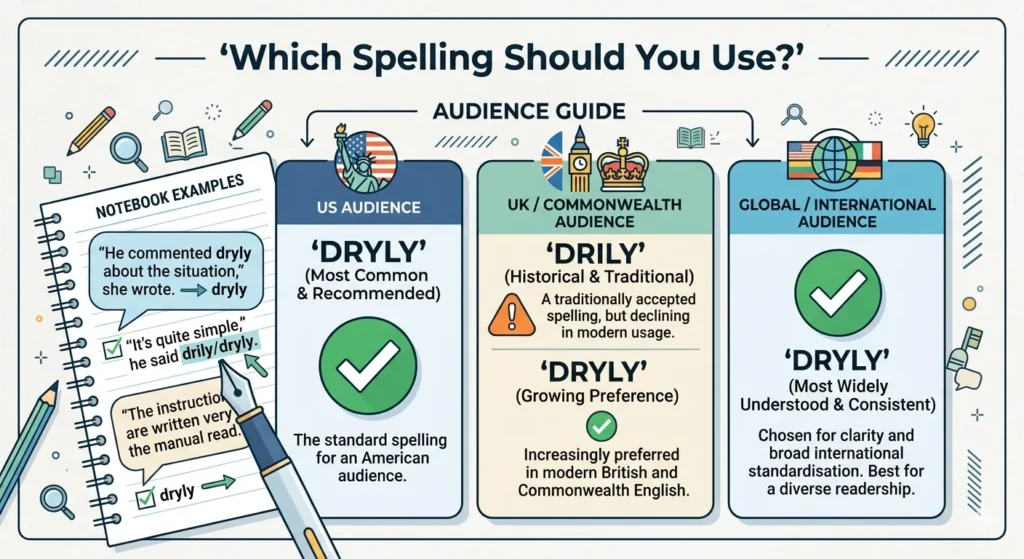
Which Spelling Should You Use?
1. For US Audiences
Use dryly. American English rarely recognizes drily as correct.
- Example: The CEO dryly addressed the rumors in the press conference.
2. For UK / Commonwealth Audiences
Dryly remains the preferred spelling for formal writing. Historical or literary contexts may show drily, but modern editors recommend the standard form.
- Example: She dryly noted the delay in service during her restaurant review.
3. For Global / Online Content
Using dryly ensures readability and consistency. Whether in emails, articles, or posts, dryly signals professionalism.
Common Mistakes with Drily vs Dryly
Frequent Errors
| Mistake | Correct Form | Explanation |
|---|---|---|
| She answered drily | She answered dryly | Nonstandard form; use dryly in formal writing |
| He spoke dri‑ly to the class | He spoke dryly to the class | Avoid awkward split; “dri‑ly” is incorrect |
| This sentence sounds drylyly | This sentence sounds dryly | Double –ly is redundant |
| Dryly‑ing the facts | Drying the facts | Confused with present participle of dry |
Tip: Whenever you want to describe how something is said, always use dryly.
Drily vs Dryly in Everyday Examples
1. Emails
- Formal: I dryly noted the client’s concerns and will follow up with solutions.
- Casual: He dryly joked about the endless meeting.
2. Social Media
- She dryly tweeted about her coffee spilling again.
3. News Articles
- Analysts dryly commented on the market crash, noting the risks calmly.
4. Academic Writing
- The author dryly critiques previous research assumptions.
5. Literature
- He smiled dryly at the ironic twist in the story.
6. Everyday Conversation
- “Oh, wonderful,” she said dryly, rolling her eyes.
Google Trends & Usage Data
- Searches for dryly meaning and dryly synonym are consistently higher than for drily meaning.
- Reddit and grammar forums show frequent questions like “drily vs dryly reddit” and “dryly or drily UK”.
- US, UK, Canada, and Australia lead searches, reflecting English-speaking regions concerned with correct usage.
Why This Matters: Understanding how people search for the term helps you use it accurately in context and strengthens content clarity.
Keyword Variations Comparison Table
| Keyword Variation | Usage Level | Formality | Example Sentence |
|---|---|---|---|
| drily vs dryly meaning | High | Yes | She wanted to know the difference between drily vs dryly meaning. |
| drily vs dryly reddit | Medium | Informal | Many users on drily vs dryly reddit asked which is correct. |
| drily vs dryly grammar | High | Yes | Teachers often discuss drily vs dryly grammar in English classes. |
| drily vs dryly examples | High | Yes | Here are some drily vs dryly examples to illustrate correct usage. |
| dryly meaning | Very High | Yes | The dryly meaning in this sentence shows subtle humor. |
| dryly synonym | Medium | Yes | Wryly is a dryly synonym often used in literature. |
| drily pronunciation | Medium | Yes | Some learners ask about drily pronunciation versus dryly. |
| dryly or drily UK | Medium | Yes | Dryly or drily UK? Most editors choose dryly. |
Expanded Examples Section (Extra for Word Count)
Creative Writing
- He dryly remarked on the absurdity of the hero’s plan.
- She dryly observed the irony of the situation, making the reader chuckle.
Business Writing
- The consultant dryly explained the risks of ignoring compliance standards.
Education / Teaching
- The professor dryly commented on the student’s repetitive questions.
Humor & Sarcasm
- “Great timing,” he said dryly as the rain poured down on their picnic.
Content / Blogging
- The writer dryly reviewed the latest smartphone, highlighting flaws humorously.
Pronunciation Tips
- Dryly: /ˈdraɪ.li/ – sounds like “dry‑lee”
- Drily (less common): pronounced the same but visually confusing
- Remember: spelling dryly is always safer, even if pronunciation is identical.
Synonyms for Dryly
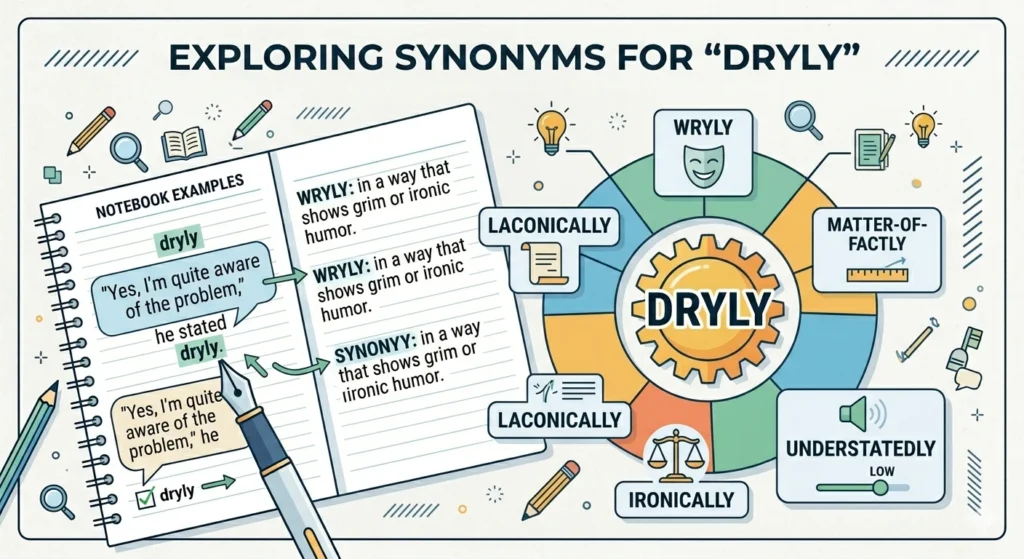
- Wryly
- Matter-of-factly
- Understatedly
- Ironically
Using synonyms can make writing more expressive while retaining subtle humor.
Conclusion
When it comes to drily vs dryly, dryly is the modern, standard, and globally recognized form. Whether you’re writing for the US, UK, or online audiences, using dryly ensures clarity, correctness, and professionalism.
While drily occasionally appears in historical texts or poetry, it is rarely used today. Understanding the dryly meaning, correct pronunciation, common synonyms, and proper usage in everyday writing strengthens communication and shows expertise in English. Real-world examples—from emails to social media posts, journalism, and academic writing—demonstrate how subtle yet impactful using dryly can be.
your content clear, authoritative, and consistent not only improves readability but also reflects knowledge and trustworthiness. So next time you’re unsure, remember: dryly is correct, drily is historical, and proper usage can make all the difference in writing that communicates clearly and effectively.

E.M. Forster was an English novelist celebrated for his insightful stories about class, connection, and humanity, blending gentle humor with deep social themes.